




JDN INC., a member of the Tanseisha Group, conducted a "Survey on the Actual Conditions and Attitudes Regarding Working Styles" over eight days from Thursday, December 25, 2025 to Thursday, January 1, 2026, targeting 279 people aged 20 to 69 working in design-related positions.
JDN INC. operates "Design Jobs," a job information site specializing in design-related jobs, and "Skhole by JDN," a site that provides information on "learning x design/creativity." "Skhole by JDN" is a new site that was launched on December 22, 2025, with the aim of providing a platform where people of all generations who have a desire to learn can encounter new learning opportunities and expand their own potential.
We will use the results we learn from this survey to disseminate information on the websites we operate.
Survey Background
With the spread of generative AI and diversifying work styles, the design industry is at a major turning point. We conducted this survey to visualize the career perspectives and true feelings of those on the front lines. By publishing the survey results, we aim to create an environment where designers can continue to thrive and promote optimal matching with companies.
Survey results summary
■ [Values are reversed] Young people value "remuneration" and seniors value "satisfaction."
We found that the factors people prioritize in continuing to work long term change with age. Approximately half of people in their 20s to 40s tend to prioritize "salary level." However, the focus shifts from their 50s onwards, with 80.0% of people in their 60s and older prioritizing "job satisfaction."
■ [Sensitivity to AI transformation] Half of designers in their 50s foresee a "drastic change in their roles"
When asked about the impact of AI on work styles and roles, 46.9% of people in their 50s responded that it would "change significantly," far exceeding the 20-somethings (24.7%). This suggests that those with many years of experience may be feeling more nervous about structural change.
■ [Skill acquisition] Young people improve their efficiency through "SNS and videos," while veterans try things out "on the job."
There are generational differences in how people learn new design tools and skills, with over 40% of people in their 20s and 30s tending to use social media and videos as their main learning sources, while those in their 50s and older are more likely to learn through trial and error while on the job.
■ [40-somethings looking to become hybrids] "I won't change jobs, I'm keen to have a side job" - the reality of the middle class
Among those in their 40s, over 30% are "not considering changing jobs," indicating a tendency to stay put, while 62.7% expressed interest in a side job, the highest result of any generation. This suggests that people are looking to expand their field of activity while maintaining stability. In addition to a stable position within the company, it seems that creating an environment that allows for outside activities such as side jobs will be an important point.
Survey results
Q1. Please select all the factors that you think are important for continuing to work for a long time.
Multiple answers (n=279)
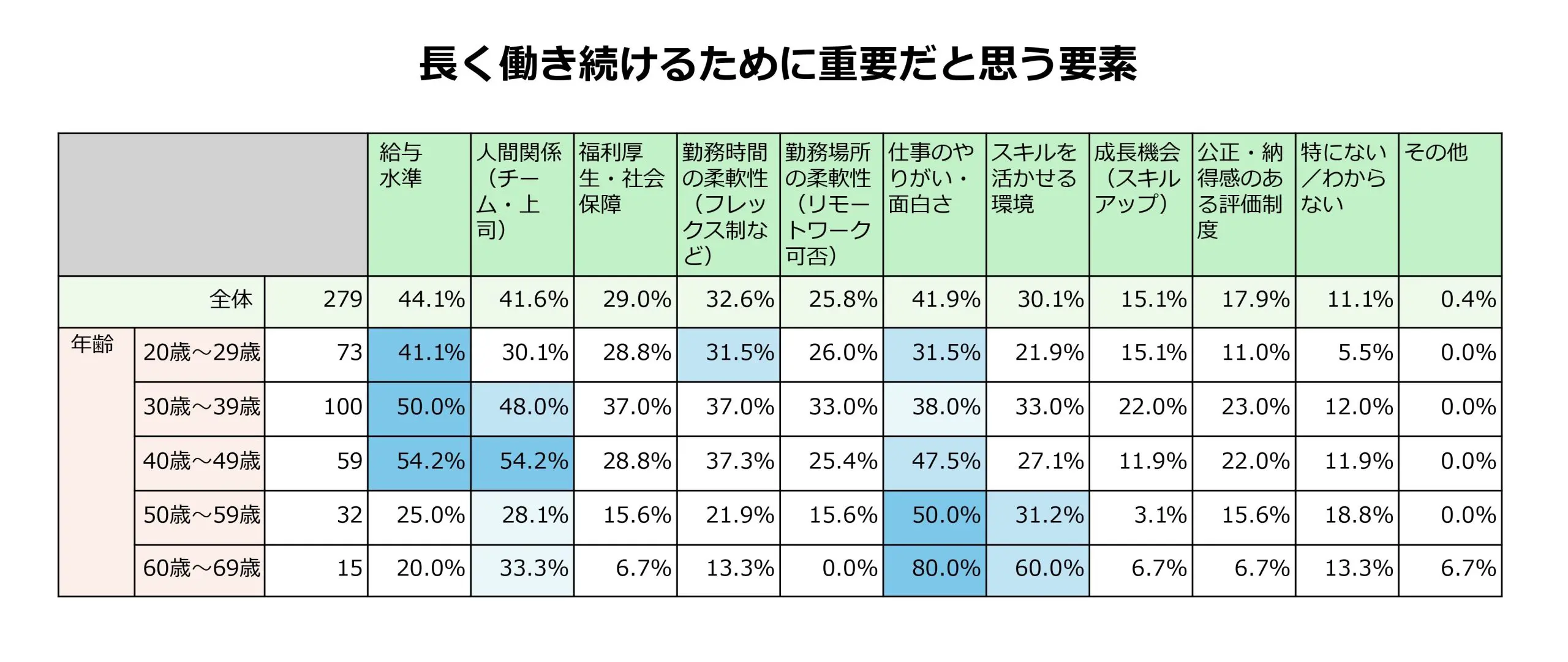
When asked about factors that motivate people to continue working long-term, up until their 40s, roughly half place importance on "salary level" and seek an economic foundation, but awareness of "job satisfaction" increases with age. Among those in their 60s and older, 80.0% place importance on job satisfaction, far exceeding salary (20.0%). This highlights the clear shift in motivation for working between generations, from compensation to self-actualization. Additionally, those in their 30s and 40s tend to value "human relationships (team/superior)," while those in their 20s to 40s tend to value "flexible working hours." Those in their 60s and older place a high value on "an environment where they can utilize their skills," suggesting a desire for a place where they can demonstrate their experience.
Q2. To what extent do you think the spread of AI will change the way we work and the role of designers?
Single answer (n=279)
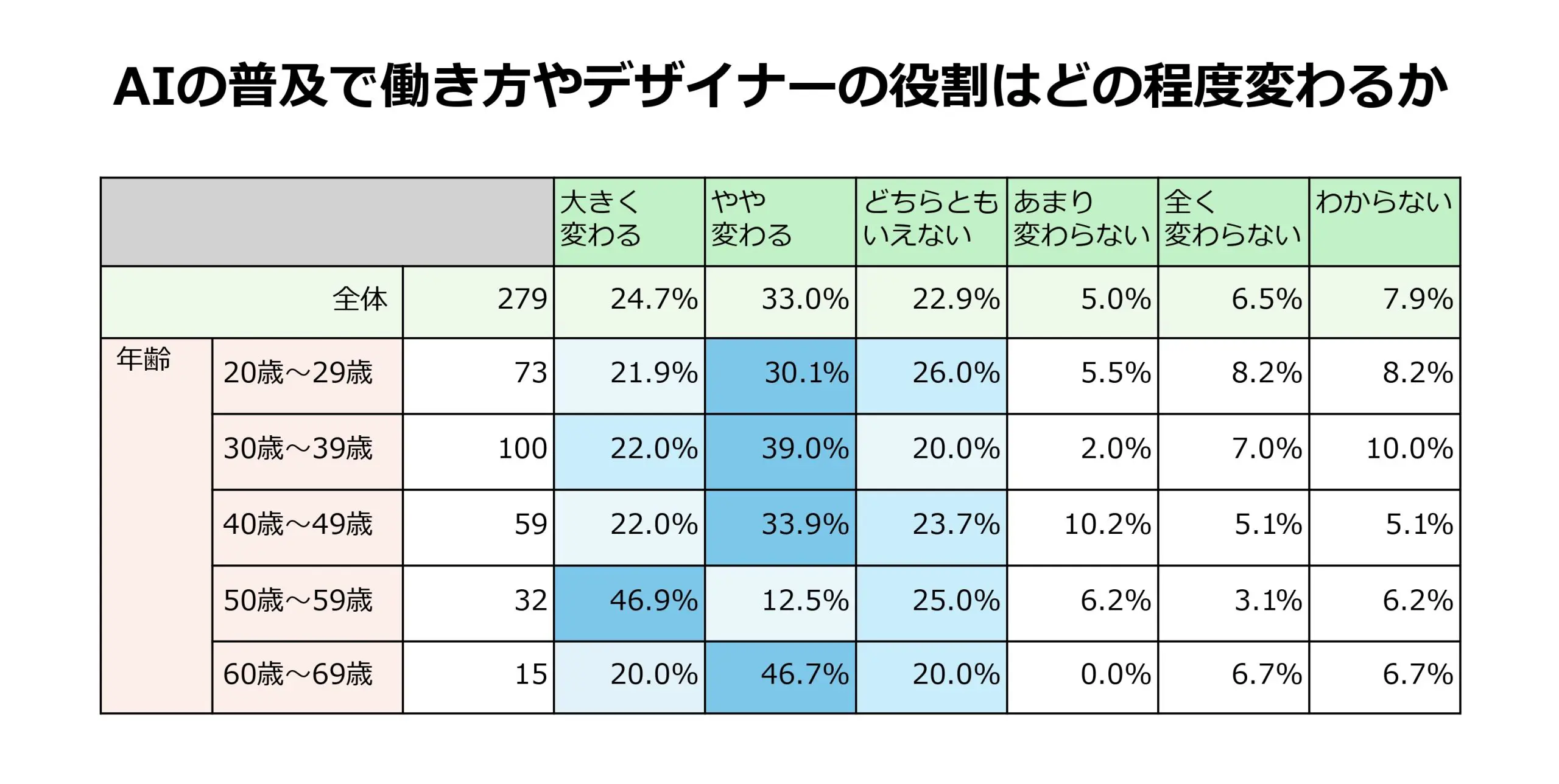
Regarding changes in work styles and roles due to the spread of AI, 57.7% of respondents predicted that "it will change." Of these, 46.9% of those in their 50s answered that "it will change significantly," the highest percentage of all generations. This is nearly double the gap with those in their 20s (24.7%), suggesting tension among veterans who are closely watching the possibility of their own job functions being redefined. On the other hand, younger generations already see AI as part of the environment, suggesting they may be adapting flexibly to changes that will occur.
Q3. How do you think the spread of AI will change the way we work and the role of designers?
Free response (n=145)
★ [Changing roles] From "production" to "selection and supervision"
There was an opinion that as AI takes over production work, the role of designers will shift to more upstream processes and decision-making tasks.
・Since production will be handled by AI, the role of the designer will become more of a Direction one (30s)
・We need to consider the plans provided by AI and think about how to utilize them (60s)
・It is necessary to be involved not only in design but also in upstream processes such as marketing and planning (30s)
・It seems that new skills such as the ability to give instructions and control will be required to get AI to create what we want (30s)
★ [Improved productivity] Dramatically reduce time and maximize number of trials
There was a positive response to the streamlining of time-consuming processes such as research, rough drafting, and finding materials.
・Reduces the time required to create proposals and increases the number of rough design proposals (60s)
・It reduces the time spent searching because you can generate materials that suit the client without having to search for them (40s)
・It will be easier to provide answers or proposals that better meet the client's needs (30s)
・I think I will spend more time thinking about how to make ideas a reality than coming up with ideas (30s)
★ [Market polarization] Redefining expertise due to "lowering entry barriers" for designers
Some have said that if "anyone can make it," the value of design as a simple task will decrease and true expertise will be called into question.
・There will likely be an increase in freelancers calling themselves designers even if they don't have the skills (40s)
・I think there will be less work because anyone can easily design. I also think the amount of money paid will decrease (50s).
・It's becoming a mass production of inferior products, and the polarization between high-class and low-class products is progressing (50s)
・As more and more things become available to everyone, I think we will enter an era where specialized knowledge and experience will be in greater demand (30s)
Q4. How are you currently learning about new design tools and skills?
Multiple answers (n=279)
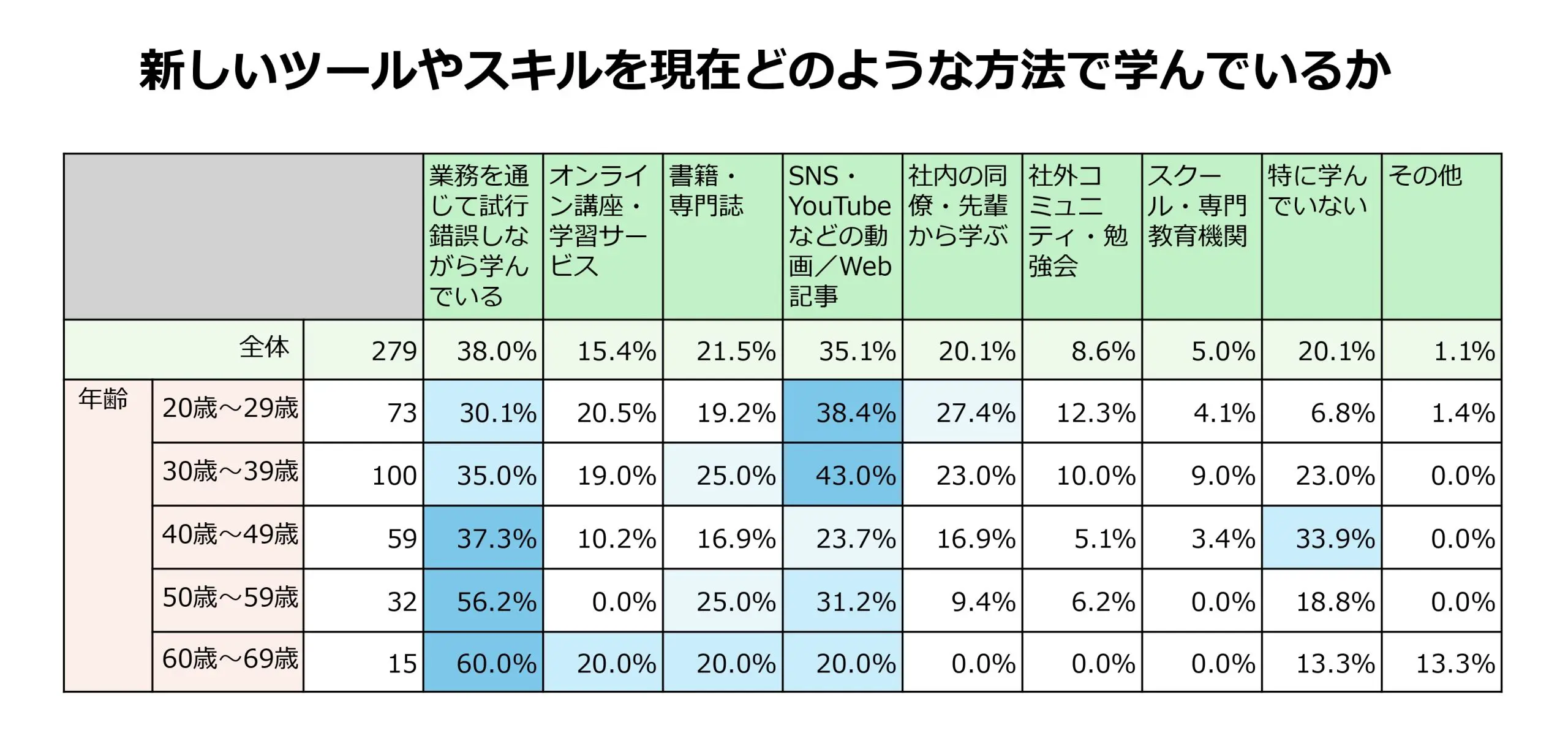
The digital shift between generations is clearly evident in the way people learn new technologies and skills. 38.4% of people in their 20s and 43.0% of people in their 30s use "videos on social media, YouTube, etc., and web articles" as their primary learning method. Meanwhile, 56.2% of people in their 50s and older place importance on "trial and error through work," suggesting that a learning environment suited to different generations may be the key to accelerating skill development in organizations.
Q5. Please tell us about your current intentions for changing jobs.
Single answer (n=279)
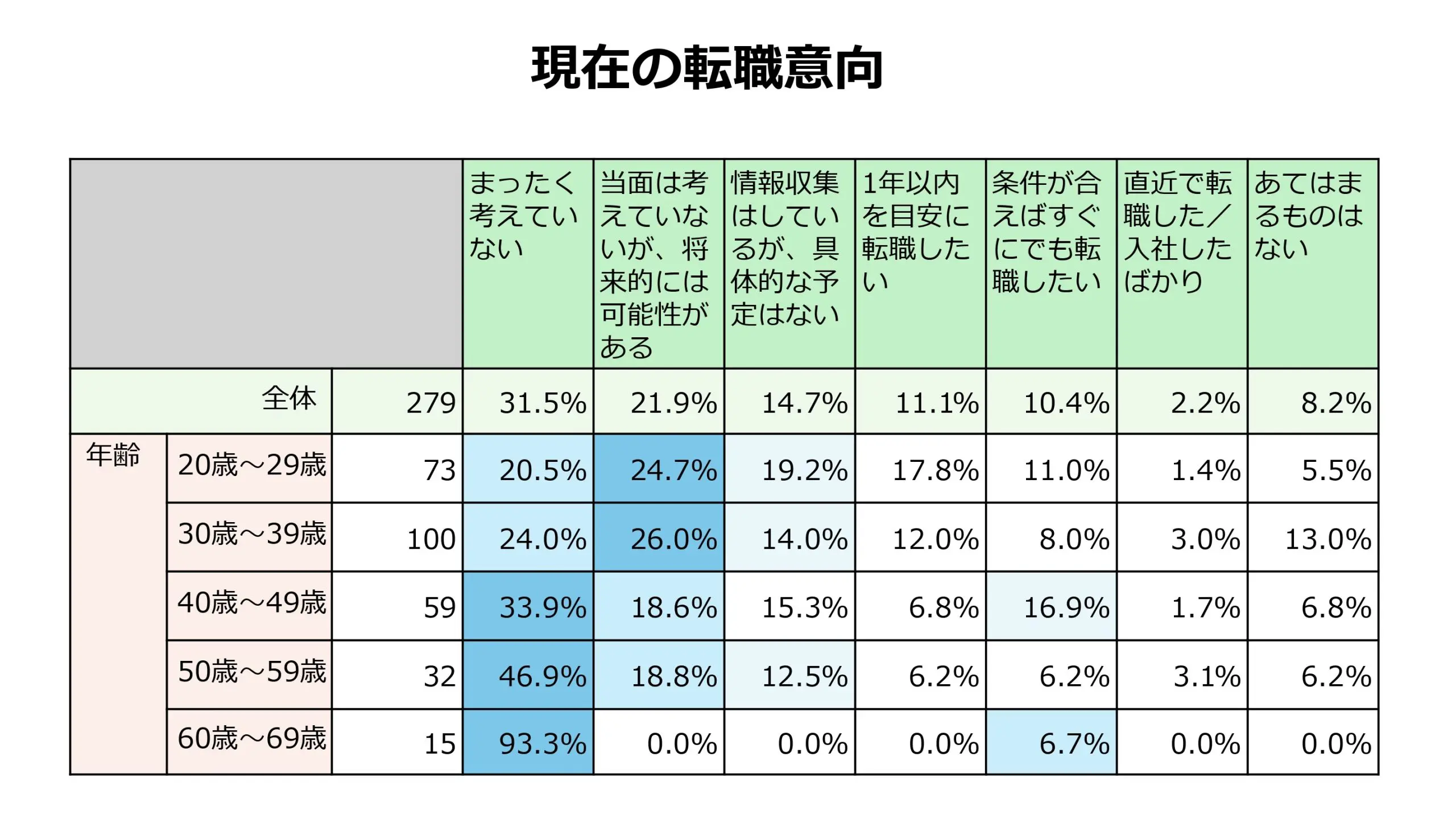
There is a current trend in people's intentions to change jobs towards "settling down" as they get older. Among those in their 40s, 33.9% said they were "not considering it at all," surpassing the 20.5% who said they were more interested in settling down in work. Meanwhile, the percentage of those in their 40s who responded that they "would like to change jobs immediately if the conditions were right" was 16.9%, the highest of all generations, surpassing those in their 20s (11.0%) and 30s (8.0%). While they value stability, there is a tendency for them to be interested in better conditions.
Q6. Are you interested in a side job?
Single answer (n=279)
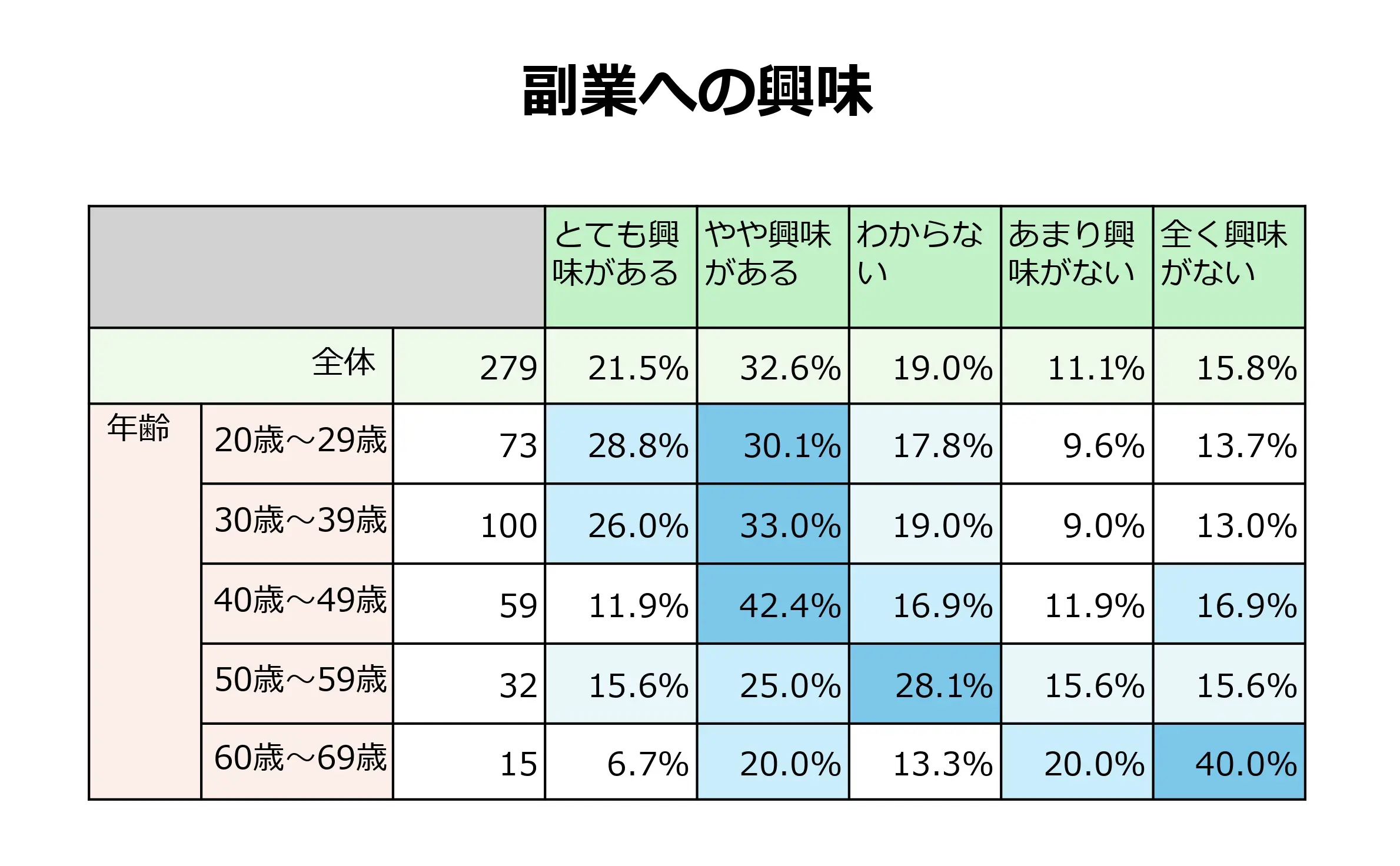
Over 50% of respondents overall were interested in side jobs, indicating a high level of interest in side jobs among designers. The highest percentage of respondents who answered "somewhat interested" was those in their 40s (42.4%) of all generations. While people in their 40s have a relatively high desire to stay in their current job, it appears that there is a large segment of people who are potentially interested in expanding their careers through side jobs. Meanwhile, 40% of those in their 60s and older answered "not interested at all," revealing a difference in attitude between generations.
<Survey Overview>
Survey subjects: Nationwide employed people aged 20 to 69 working in design-related occupations
Survey period: 8 days from Thursday, December 25, 2025 to Thursday, January 1, 2026
Sample size: 279 people
Survey method: Online questionnaire survey
About JDN INC.
Design information site "JDN"
 Since its launch in 1997, the site has focused on "design" and has provided information on design from a wide range of angles, including the latest domestic and international news, introductions to notable designers, interviews, and event information.
Contest information site "Toryumon"
 It is one of Japan's largest information websites, introducing over 2,000 contests per year that can be participated in from Japan. We aim to connect the two parties by providing readers with the latest contest information and organizers and public relations personnel with a platform for disseminating high-quality information.
Job site "Design Jobs"
 This job information website was launched in 2002 as an independent version of the job information section that was available in the original JDN magazine. To date, it has introduced over 10,000 job listings in the design and creative fields, including graphics, product design, architecture, spatial and display design, web design, and fashion design.
Learning and design information site "Skhole by JDN"
 We provide information on "learning x design/creativity" to all generations who have the desire to learn. We aim to be a platform where you can encounter new learning opportunities and broaden your own possibilities.
Please note that this may be subject to change without prior notice.