




Site Search
Sustainability Management
- TOP
- Sustainability
- Sustainability Management
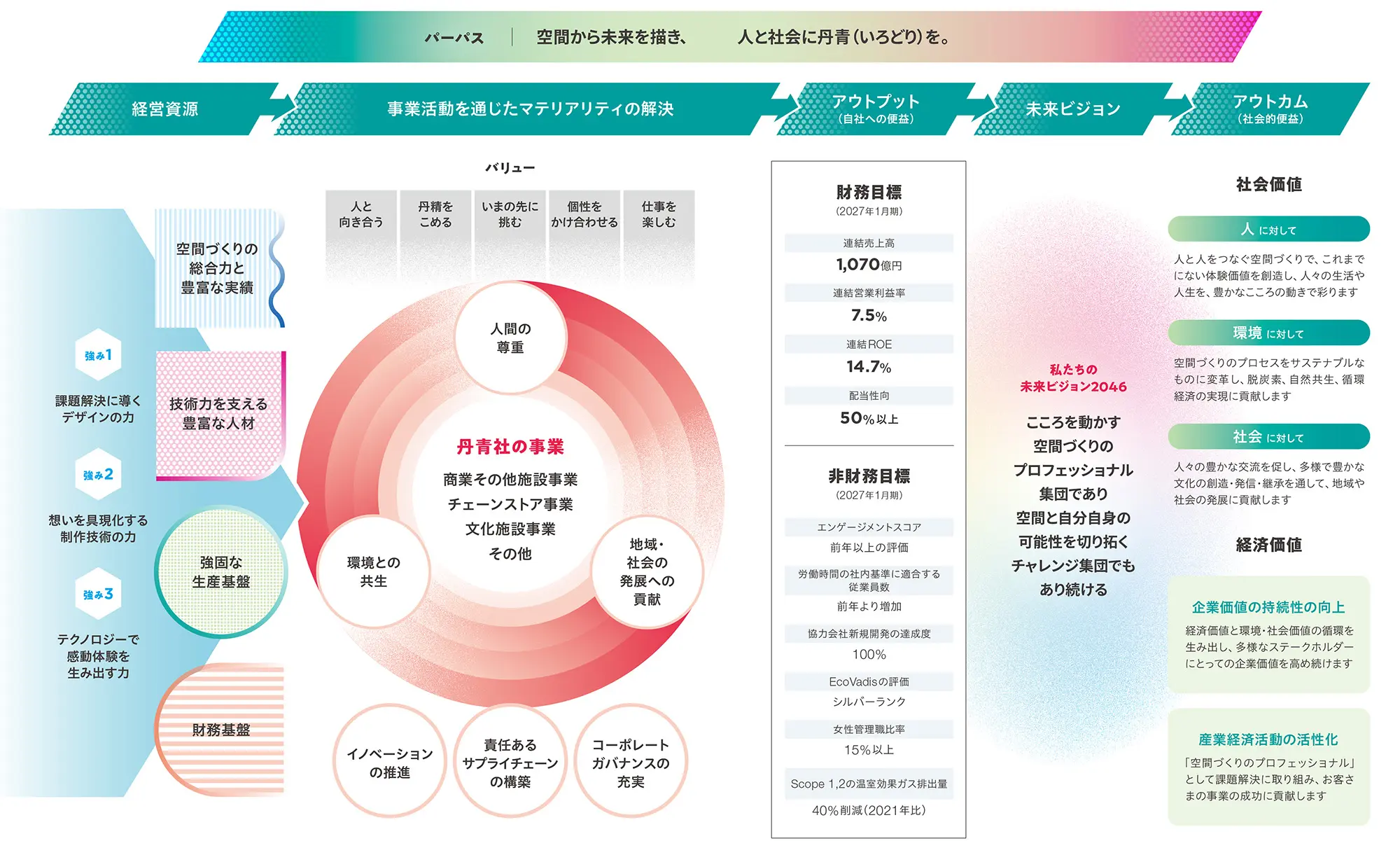
Value Creation Process
Group Code of Conduct
The Tanseisha Group has established the following "Tanseisha Group Code of Conduct" to ensure ethical, responsible, and conscientious conduct among its Director, employees, and other personnel. This code is reviewed periodically to reflect changes in the company and society, and is submitted to the Board Director after consideration by the Sustainability Committee, chaired by the President of Tanseisha. The latest revision was implemented in February 2025.
Tanseisha Group Standards of Practice
All Tanseisha Group companies will not only comply with laws and regulations, but will also respect social norms and conduct business activities with high ethical standards, good sense, and responsibility in order to realize a sustainable society. To this end, we will support and respect international norms(※) and establish the following standards of conduct that should be followed by the officers and employees of Tanseisha Group companies.
Furthermore, upon adoption by the boards of directors of each respective Group company, this Code of Conduct will apply to officers, employees, and other individuals in an employment relationship with each Tanseisha Group company.
* "OECD Guidelines for Multinational Enterprises," "OECD Due Diligence Guidance for Responsible Business Conduct," International Labor Organization (ILO) "Declaration on Fundamental Principles and Rights at Work," "United Nations Global Compact," "Universal Declaration of Human Rights," United Nations "Guiding Principles on Business and Human Rights," Keidanren "Charter of Corporate Behavior," etc.
- Contribute to a sustainable society.
Through creating better spaces, we contribute to the development of solutions to social issues and realize a sustainable society. - Abide by the law, respect for social norms.
We observe and follow all pertaining laws, respect social standards and fulfill our services with sound judgement and responsibility. - Fair business practices.
We carry out business operations in a proper manner so as to promote fair and free competition and procure all necessary resources responsibly. We uphold wholesome relationships with administrative and government sectors and do not accept any form of bribery or unjust profits. - Appropriate information management and disclosure, as well as wholesome dialogue with stakeholders.
We actively and effectively disclose company information, carry out wholesome dialogue with our diverse populace of stakeholders and strive to progress our company value.
- We respect laws and regulations, observe just accounting practices and announce results accordingly.
- We disclose correct company information in a fair and timely manner to all stakeholders including shareholders and investors.
- We strive to prevent all inappropriate disclosure, leaking and wrong usage of company information.
- We do not conduct insider trading or other misuse of unannounced company information.
- We build long-lasting trust with a vast array of stakeholders via continual dialogue.
- Respect human rights, prohibit discrimination.
We carry out business practices with the upmost respect to the human rights of all individuals involved.
- We respect the rights and diversity of all people, and offer a working environment without discriminating between nationality, race, ethnicity, religion, ideology, gender, age, handicap, sexual identity, sexual preference, or employment status.
- We do not allow for any form of harassment, be it mental or physical.
- We do not allow child labor or any form of forced labor.
- We uphold labor rights, including freedom of association, rights to form unions and to carry out negotiation between union and employer.
- Trusting relationship with customers and users.
We conduct honest communication with all customers and users of spaces, products, and services that companies in the Tanseisha Group have provided, until we gain the understanding and trust of those individuals. We also strive to create spaces based on universal design concepts so that they may be used freely and at ease by all. - Protecting intellectual property and private information.
The intellectual results of each company in the Tanseisha Group is protected by intellectual property rights. We actively uphold these rights and the due intellectual property rights of third parties involved. We protect the private information of individuals and take proper measures when collecting, implementing and managing that information. - Creating a better working environment.
We respect the diversity of all levels of staff. We strive to create a working environment for all to hone and make use of their abilities, while maintaining a wholesome and safe space that is easy to work in. - Coexistence with the environment.
We strive to create a sustainable circular society with low carbon emissions, where people can coexist with their surrounding natural environment. - Contributing to societal participation and development.
As corporate citizens, we actively participate in our respective communities and contribute to the development of a shared society. - Thorough risk management.
We take thorough measures to manage the risks faced as a corporation, including such risks as natural disasters and anti-social forces or organized crime that mean harm to the livelihoods of individuals and corporate practices.
- We refuse to have any relations with groups opposed to the wellbeing of society. We firmly reject all unjust demands from said groups and deal with any arising issues through civil and criminal action.
- We provide organized procedures and training in case of possible, foreseen natural disasters.
- Measures against misbehavior among business executives and top officials.
Personnel in executive positions uphold their responsibilities to build effective governance, and work in compliance to business ethics with regards to partners across the supply chain, not to mention all companies in the Tanseisha Group. In the case that preset behavior regulations are ever violated, individuals in the respective top positions take it upon themselves to investigate the root cause and prevent any further occurrence and take necessary measures in order to solve the issue at hand.
Established May 12, 2006
Revised February 1, 2025
President and Chief Executive Officer Osamu Kobayashi
Sustainability Policy
Tanseisha Group Sustainability Policy
Through our business of creating valuable spaces
we address environmental and social challenges with sincerity.
By working diligently to resolve those issues,
we aim to enhance our corporate value sustainably
while contributing to the realization of a colorful and sustainable society.
Established October 1, 2024
President and Chief Executive Officer Osamu Kobayashi
Sustainability Promotion System
Sustainability Committee
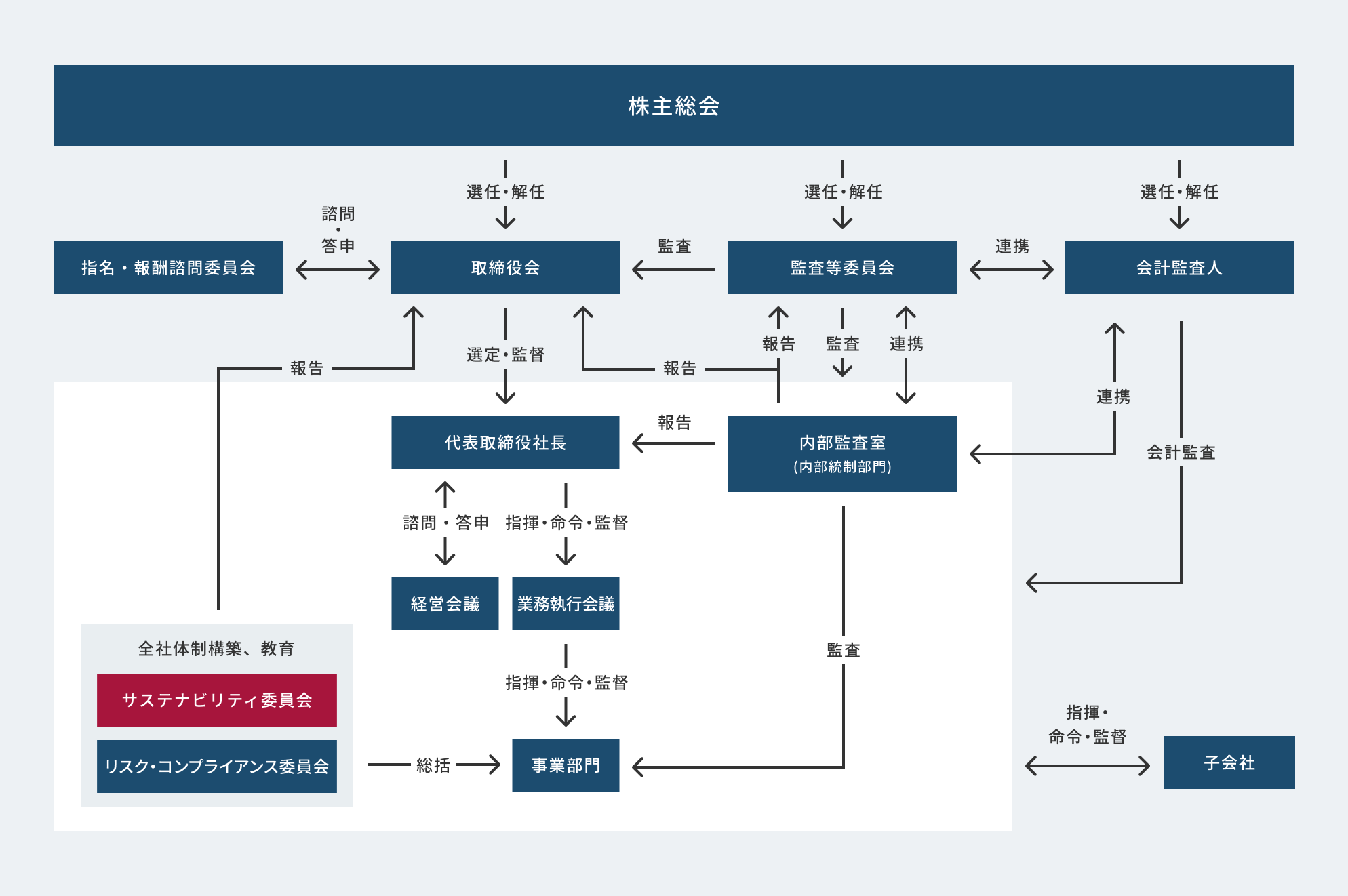
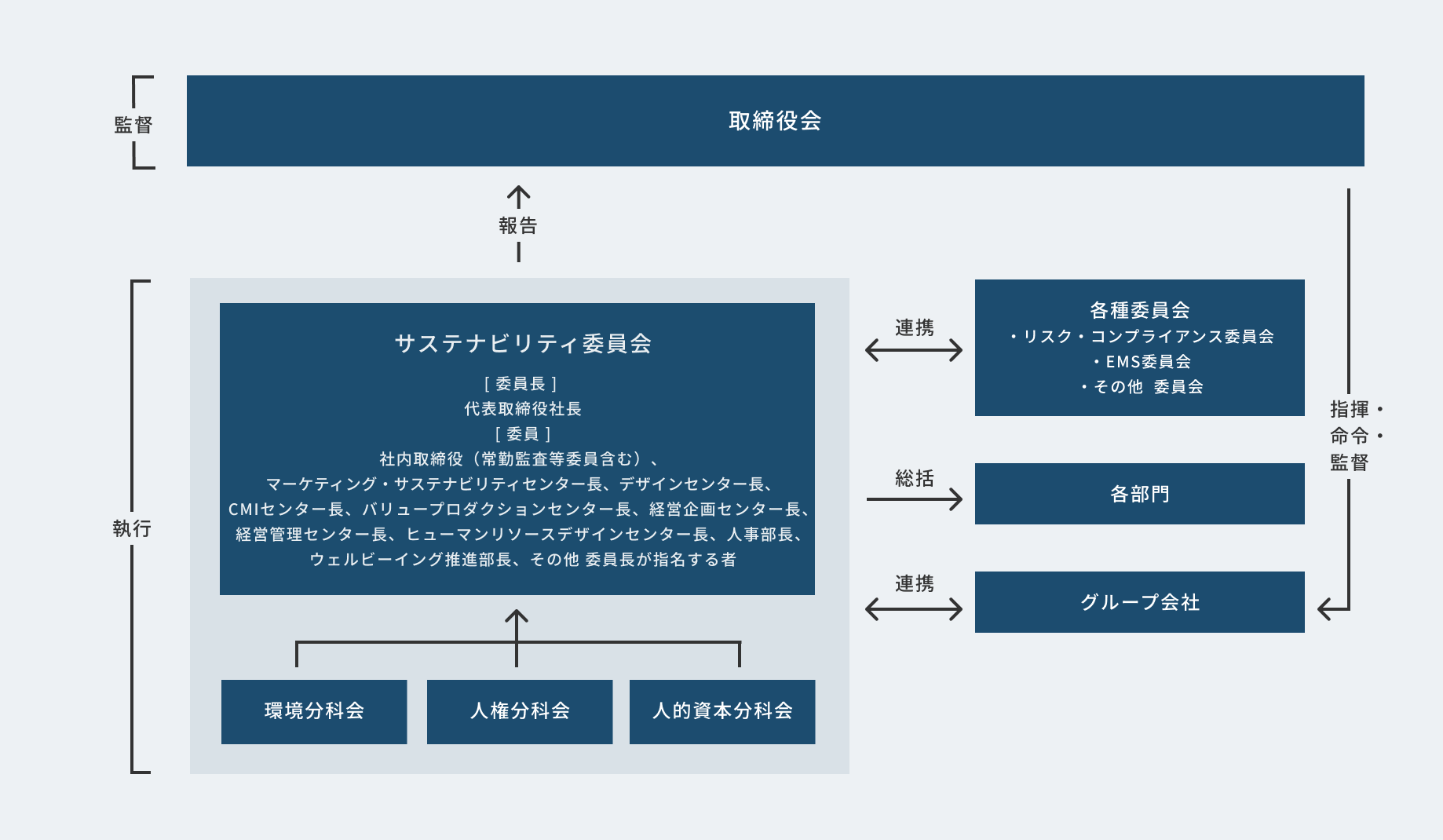
We have established a Sustainability Committee, chaired by the President and comprised of the heads Marketing & Sustainability Headquarters, Design Center, Cross Media Innovation Headquarters, Value Production Headquarters, Corporate Planning Headquarters, General Management Headquarters, Human Resources Design Center, Human Resources Department, and Well-Being Promotion Department. The committee meets monthly and is responsible for formulating and reviewing important sustainability policies and regularly reviews sustainability activities, striving to enhance sustainability initiatives in each division and field. The committee's deliberations and status are regularly reported to the Board Director, and the establishment, revision, and abolition of important sustainability policies are deliberated by the committee and then submitted to the Board Director for deliberation and decision-making. Regarding "environmental response," "human capital management," and "human rights," the committee has established subcommittees specializing in these themes, which carry out activities tailored to each theme.
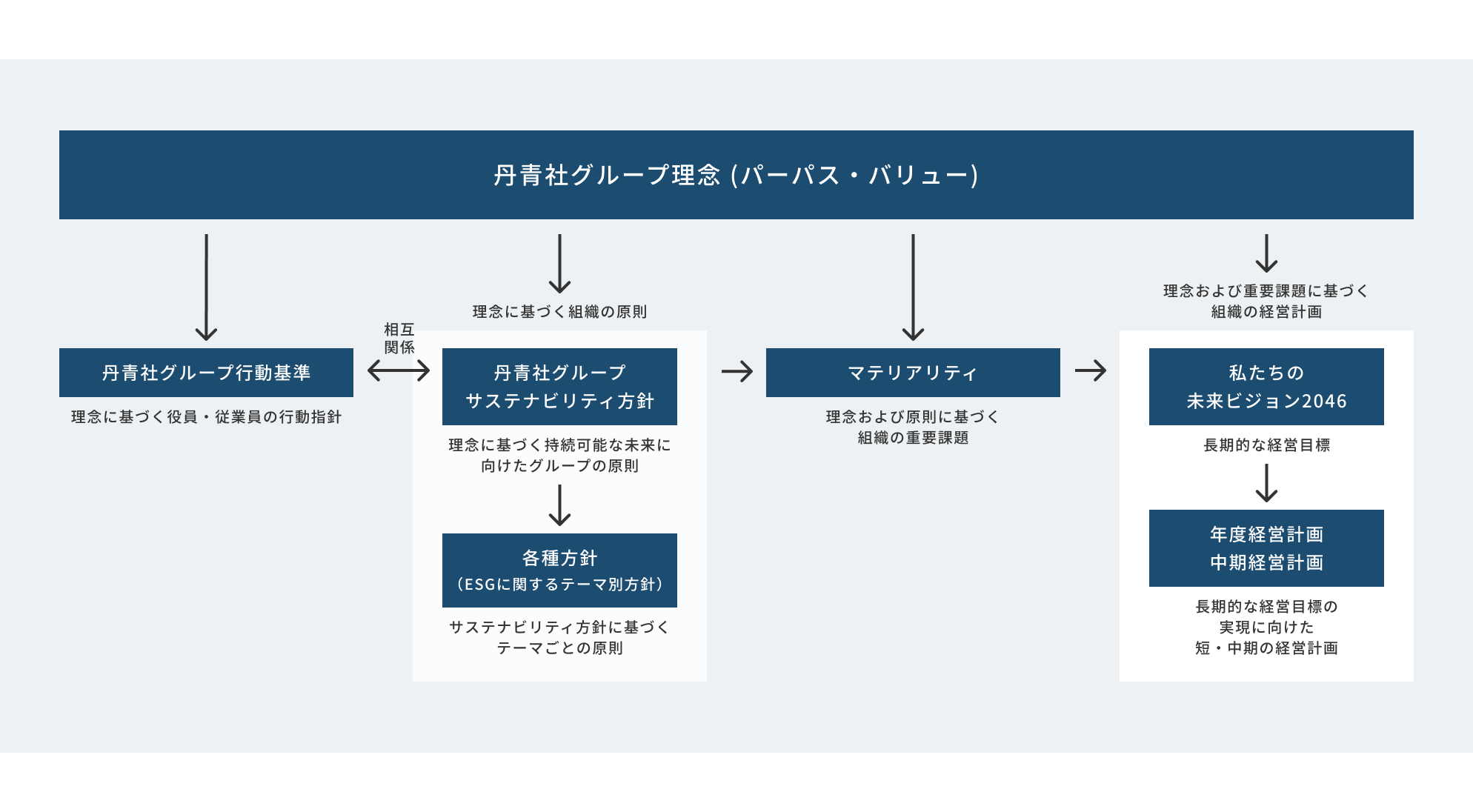
List of policies
General
Environmental
Social
- ・ Tanseisha Group Human Rights Policy
- ・ Human resource policies (human resource policies, desired talent profile, recruitment policies, human resource development policies)
- ・ Tanseisha Group Well-being Management Policy
- ・ Tanseisha Group DE&I Policy
- ・ Tanseisha Group Sustainable Procurement Policy
- ・ Tanseisha Group Sustainable Procurement Guidelines
- ・ Tanseisha Group Safety and Health Policy
- ・ Tanseisha Group Quality Policy
Governance
- ・ Basic Policy on Corporate Governance (PDF)
- ・ Information Security Policy
- ・ Basic Policy for Building an Internal Control System (PDF)
- ・ Policy for determining directors' remuneration, etc. (PDF)
- · Privacy Policy
- ・ Basic policy regarding the proper handling of specific personal information
- ・ Social Media Policy
- ・ Multi-stakeholder policy
- Tanseisha Group's Customer Harassment Response Policy
- Policy to prevent sexual harassment/power harassment against job seekers, etc.
- ・ Tanseisha Group BCP Policy
Sustainability awareness activities/internal awards
We hold sustainability study sessions for management across all Tanseisha Group companies. We also provide sustainability training (e-learning) for all executives and employees, including information on sustainability in general. In particular, we incorporate appropriate content into the training on "human rights," a topic that is particularly relevant to our group's business, to ensure that the Tanseisha Group Human Rights Policy is understood, embedded in business activities, and implemented effectively. We also provide separate training focused on the themes of "compliance" and "harassment." Regarding the "environment," we conduct training aimed at putting our environmental policy into practice.
We also hold the Sustainability Solution Awards, which invites company-wide submissions of projects that contribute to sustainability and awards them internally. We also use the awards as an opportunity to raise awareness within the company, providing an opportunity to present details of the winning projects and share information within the company. We also hold seminars both internally and externally with the aim of improving basic understanding of sustainability. Furthermore, we foster awareness of sustainability by providing education (workshops) by external lecturers for selected members.
We create, update, and maintain a portfolio of achievements and pamphlets based on information on our achievements and activities so that we can introduce our sustainability-related initiatives to external stakeholders. We also use this information to make proposals to clients on how to promote sustainability in spatial design.
External Initiatives and Participating Organizations
Comprehensive Commitment
United Nations Global Compact
The United Nations Global Compact (UNGC) is the world's largest sustainability initiative, bringing together the United Nations and the private sector (companies and organizations) to build a healthy global society.
Tanseisha supports the UNGC's 10 principles in the four areas of "human rights," "labor," "environment," and "anti-corruption," and is committed to solving social issues through its business activities, aiming to realize a sustainable society.

United Nations Global Compact website
Global Compact Network Japan website
Environmental and Climate Change Initiative
TCFD (Task Force on Climate-related Financial Disclosures)
To appropriately understand and manage the risks and opportunities that climate change presents to our business activities, we promote information disclosure in line with the four frameworks recommended by the TCFD recommendations: "governance," "strategy," "risk management," and "indicators and targets." We continuously assess and analyze the climate-related impacts on our business activities and strive for highly transparent information disclosure and concrete countermeasures through our website and other channels.
Related information
TOP > Sustainability > ESG Initiatives: E (Environment) > Climate Change Response (TCFD Disclosure)
SBT (Science Based Targets) initiative
Our company considers reducing greenhouse gas (GHG) emissions from our business activities to be a key issue. We endorse the principles of the Science Based Targets initiative (SBTi), an international climate change initiative, and are setting and promoting reduction targets that are consistent with its standards.
Our "Near-Term Targets" set for fiscal year 2030 are based on scientific knowledge from organizations such as the IPCC (Intergovernmental Panel on Climate Change) and are calculated backward from the goal of achieving net-zero global GHG emissions by 2050, aligning with the scientifically-based reduction pace required of companies. These targets were validated by the SBTi in September 2026 as scientifically-based targets.

Related information
TOP > Sustainability > ESG Initiatives: E (Environment) > Climate Change Response (TCFD Disclosure): Validation of SBT (Science Based Targets)
"SBT (Science Based Targets) Initiative" website
Social, supply chain, and human capital
Declaration of Partnership Building
We declare our commitment to building equal partnerships with our supply chain partners, promoting fair trade practices, and enhancing added value across the entire value chain.
Related information
TOP > Sustainability > ESG Initiatives: S (Social) > Supply Chain
International Association for Universal Design (IAUD)
We contribute to the creation and social implementation of universal design spaces that can be comfortably used by all people, regardless of age, gender, disability, etc.
Sustainable Events Council
We promote resource recycling, reduction of environmental impact, and standardization and dissemination of sustainable event management practices at events and exhibitions.
Related information
TOP > Sustainability > ESG Initiatives: S (Social) > Wellbeing: Collaboration with other companies to nurture the next generation
Industry associations and design promotion
Our company is a member of and collaborates with the following industry organizations with the aim of developing spatial design culture, improving safety and hygiene at construction sites, and addressing industry-led sustainability challenges.
- Japan Spatial Design Association (DSA)
- Japan Sign Design Association (SDA)
- Japan Commercial Environmental Design Association (JCD)
- Japan Event Industry Promotion Association (JACE)
- Tokyo Display Cooperative Association
- Japan Design Association (a specified non-profit organization), and others.
Collaboration with industry groups on climate change
Development and operation of the industry-standard carbon calculator "EVENT CARBON SIMULATOR"
Our company has been developing "EVENT CARBON SIMULATOR," an industry-standard carbon calculator for event activity processes, in collaboration with development partner companies affiliated with the Japan Event Industry Promotion Association (JACE). We have now formed an "Operation Working Group" with 15 JACE member companies and have begun trial operations toward a future public release.