




Site Search
Supply chain
- TOP
- Sustainability
- ESG Initiatives: S (Society)
- Supply chain
Sustainable Procurement Policy/Guidelines
Tanseisha Group Sustainable Procurement Policy and Guidelines
Based on its purpose, "Drawing the future from space, adding new colors to people and society." the Tanseisha Group has established a sustainability policy stating, "Through our business of creating valuable spaces, we will confront environmental and social issues and sincerely work to solve them, thereby aiming for the sustainable improvement of corporate value and contributing to the realization of a vibrant and sustainable society." To achieve these goals, we have established the "Tanseisha Group Sustainable Procurement Policy" and the "Tanseisha Group Sustainable Procurement Guidelines" to build strong relationships of trust with our business partners, including our collaborating companies, and to aim for the resolution of environmental and social issues throughout the entire supply chain.
The "Tanseisha Group Sustainable Procurement Policy" indicates the basic stance that the Tanseisha Group should take towards sustainable procurement, and the "Tanseisha Group Sustainable Procurement Guidelines" encourage our group and our partner companies to put into practice efforts in accordance with the policy. We also ask our partner companies to encourage efforts based on this policy and guidelines, and by promoting understanding and penetration of these guidelines, we will promote sustainable procurement activities throughout the entire supply chain.
Tanseisha Group Sustainable Procurement Policy
- Compliance with laws and regulations and respect for social norms
We will comply with the laws and regulations applicable in the countries and regions in which we conduct business, and will respect social norms. - Fair and impartial trading
We will take a fair and impartial approach to transactions, provide a wide range of trading opportunities, and make selections based on economic rationality by comprehensively evaluating safety, technical capabilities, price, delivery time, environmental friendliness, business situation, etc. - Thorough corporate ethics
We will conduct procurement activities with the highest ethical standards. - Maintenance and improvement of occupational safety and health
We will establish a system for managing safety and health, proactively ensure safety, including by third parties, and improve the working environment, striving to maintain and improve safety and health. - Ensuring quality and safety
For all services, we strive to understand customer needs and ensure appropriate quality as well as safety and security. - Respect for human rights
Based on the Tanseisha Group Human Rights Policy, we respect basic human rights throughout our supply chain. - Environmental Considerations
We are committed to protecting Environmental Consideration and reducing the burden on the environment through all of our corporate activities, including Environmental Consideration in spatial creation, such as eco-conscious design and reducing industrial waste generation, and will contribute to the realization of a decarbonized, symbiotic society and a circular economy. - Protection and respect of intellectual property rights
We respect and protect the legitimate intellectual property rights of third parties. - Ensuring information security
We will endeavor to ensure information security by taking into consideration the protection of personal information, confidential information, and customer information related to our business. - Contribution to Society
We will utilize our management resources to engage in activities that contribute to the development of the local community and society. - Responding to disasters and other unforeseen circumstances
We will prepare for large-scale disasters and other unforeseen circumstances during peacetime by establishing a risk management system and developing a business continuity plan, and will actively support and cooperate in the recovery and restoration efforts in the event of a disaster.
Established on August 1, 2019
Revised on February 1, 2025
President and Chief Executive Officer Osamu Kobayashi
Tanseisha Group Sustainable Procurement Guidelines
- Compliance with laws and regulations and respect for social norms
We will comply with the laws and regulations applicable in the countries and regions in which we conduct business, and will respect social norms.- We will comply with all domestic and international laws and regulations (Construction Business Act, Subcontract Act, Personal Information Protection Act, Copyright Act, Environmental Protection Act, Labor Act, etc.) that govern our business activities, and respect social norms.
- We have established an internal reporting system for our employees and partner companies, and will thoroughly protect the confidentiality and rights of whistleblowers, and use the content of reports to improve corporate behavior.
- Fair and impartial trading
We will take a fair and impartial approach to transactions, provide a wide range of trading opportunities, and make selections based on economic rationality by comprehensively evaluating safety, technical capabilities, price, delivery time, environmental friendliness, business situation, etc.- We will conclude business agreements in accordance with fair and transparent procedures, including receiving appropriate quotations and entering into written contracts before construction begins.
- When conducting business, we select suppliers based on a comprehensive evaluation of factors such as cost competitiveness, quality assurance, reliability of delivery dates, technical capabilities, financial strength, social credibility as a company, consideration for social issues such as the environment and human rights, and business performance.
- In transactions, we prohibit the abuse of a dominant bargaining position, such as seeking unfair benefits or preferential treatment, and refrain from any actions that impede transparency and free competition, conducting transactions on an equal footing.
- We will disclose corporate information, including management details, business activities, and sustainability activities, voluntarily, in a timely and appropriate manner, and promote communication with a wide range of stakeholders.
- Thorough corporate ethics
We will conduct procurement activities with the highest ethical standards.- We will reject all ties with antisocial forces and will firmly refuse any unreasonable demands.
- We will maintain transparent and healthy relationships with all stakeholders and will not engage in any unethical acts, including bribery, extortion, embezzlement, or other corrupt practices.
- Maintenance and improvement of occupational safety and health
We will establish a system for managing safety and health, proactively ensure safety, including by third parties, and improve the working environment, striving to maintain and improve safety and health.- Promotes a safe and clean working environment.
- We strive to create a comfortable working environment where everyone can work safely and in good health, both physically and mentally.
- We will promote disaster prevention activities and strive to prevent workplace accidents.
- Ensuring quality and safety
For all services, we strive to understand customer needs and ensure appropriate quality as well as safety and security.- By providing optimal construction work and related services, we ensure the quality of the construction objects (strength, functionality, durability, precision, workmanship, etc.) and the quality of the construction process that our customers require.
- We will strive to independently and continuously improve our technological capabilities in order to improve the quality of our technologies and services to resolve environmental and social issues.
- We will comply with relevant laws and regulations when improving the working environment and prevent damage to workers' health.
- We will thoroughly prevent health hazards to facility and space users through appropriate equipment planning, material selection, and construction method considerations.
- If any quality-related accidents or defects occur, we will promptly report them and take appropriate measures.
- Respect for human rights
Based on the Tanseisha Group Human Rights Policy, we respect basic human rights throughout our supply chain.- We will comply with and respect internationally recognized laws and standards regarding basic human rights and labor.
- We will not tolerate any discrimination, harassment, or other unfair treatment on the basis of nationality, race, ethnicity, religion, ideology, sex, age, disability, gender identity, sexual orientation, employment status, or any other grounds.
- We strive for mutual understanding, respect diversity, individuality and personality, and strive to create a healthy and rewarding working environment.
- We respect workers' rights, including freedom of association, the right to collective bargaining, and payment of fair wages.
- Environmental Considerations
We are committed to protecting Environmental Consideration and reducing the burden on the environment through all of our corporate activities, including Environmental Consideration in spatial creation, such as eco-conscious design and reducing industrial waste generation, and will contribute to the realization of a decarbonized, symbiotic society and a circular economy.- We will promote the improvement of environmental performance and reduction of environmental impact in spaces toward a carbon-free society.
- We will promote 3R activities, including the selection of materials and products to be used, and the development of recycling activities that contribute to the realization of a resource-circulating society.
- We will promote efforts to conserve biodiversity and ensure the sustainability of water resources, biological resources, etc., in order to create a society in harmony with nature.
- We will promote sustainable procurement and take measures to mitigate risks such as environmental pollution and environmental impacts resulting from our business activities.
- Protection and respect of intellectual property rights
We respect and protect the legitimate intellectual property rights of third parties.- We will not engage in any infringing acts such as the improper use or unauthorized use of intellectual property.
- We respect the rights of our business partners and treat them appropriately. We do not use our business position to ask for the transfer of rights.
- We will provide employees with educational programs to further their knowledge of intellectual property and ensure compliance with laws and regulations.
- Ensuring information security
We will endeavor to ensure information security by taking into consideration the protection of personal information, confidential information, and customer information related to our business.- We will properly manage, protect and provide education on personal information, customer information and confidential information to prevent unauthorized or inappropriate use, disclosure or leakage.
- We implement defensive measures against computer and network threats to prevent damage related to information leaks.
- Contribution to Society
We will utilize our management resources to engage in activities that contribute to the development of the local community and society.- We respect local cultures and customs, and strive to earn the trust of local communities by engaging sincerely with them.
- Through our business activities, we contribute to the development of local communities by creating excitement, revitalizing the area, and passing on and promoting history and culture.
- Responding to disasters and other unforeseen circumstances
We will prepare for large-scale disasters and other unforeseen circumstances during peacetime by establishing a risk management system and developing a business continuity plan, and will actively support and cooperate in the recovery and restoration efforts in the event of a disaster.- We will continue to have a risk management system in place to prepare for large-scale disasters and strive to maintain our supply chains.
- After ensuring the safety of our employees and their families, we will work to preserve Tanseisha's facilities, including worksites, and strive to restore business activities as quickly as possible.
- In order to contribute to local communities, we will cooperate with the recovery and reconstruction efforts of national and local governments.
Compliance with and incorporation of guidelines into transactions and contracts
To implement the "Tanseisha Group Sustainable Procurement Guidelines," we have included clauses in our basic construction contracts and other agreements regarding compliance with these guidelines. We require our partner companies to comply with human rights, labor, occupational safety and health, environmental protection, and anti-corruption measures. Furthermore, we stipulate that if improvements are not seen within a reasonable period after corrective recommendations are issued, or if serious violations such as child labor, forced labor, or significant environmental pollution are discovered, we will take strict measures, including contract termination.
Value chain mapping and supply chain risk assessment
To ensure our sustainable procurement policies and guidelines are implemented throughout our entire supply chain, we conducted a "value chain mapping" project targeting approximately 5,000 partner companies with whom we have had business relationships over the past three years. This project visualized the overall picture of our supply chain and its impact on our business operations.
Furthermore, a sustainability survey conducted among 193 major partner companies revealed that while 91% agreed with our policies (including partial agreement), they expressed concerns about the establishment of systems for "responding to unforeseen circumstances such as disasters," "contributing to society," and "environmental considerations." We have identified these results as risk indicators and are using them to formulate priority support areas.
Support for the Partnership Building Declaration
Tanseisha agrees with the spirit of the "Partnership Building Declaration" put forward by the Cabinet Office, the Small and Medium Enterprise Agency and others, and has published the "Partnership Building Declaration" which aims for coexistence and prosperity throughout the entire supply chain and for increasing mutual added value through new collaboration.
Tanseisha Partnership Building Declaration
We declare that we will focus on the following items in order to build new partnerships by promoting collaboration and coexistence and mutual prosperity with business partners in the supply chain and businesses seeking to create value.
-
Coexistence and mutual prosperity throughout the supply chain and new collaboration beyond scale and affiliation
Through our direct business partners, we will also work with their further business partners (from "Tier N" to "Tier N+1"), aiming to increase added value throughout the supply chain. We will also work to build mutually beneficial relationships with our business partners by collaborating beyond existing business relationships and corporate scale. In doing so, we will also provide necessary support, such as advising our business partners on introducing teleworking and formulating BCPs (Business Continuity Plans), from the perspective of business continuity in the event of a disaster and work style reform.
(Individual item) We will strive to prioritize procurement from companies that are actively engaged in environmental consideration, such as by providing products and services that have a low environmental impact. -
Compliance with the "Promotion Standards"
We will comply with desirable business practices between parent companies and subcontractors ("promotion standards" based on the Subcontracting Small and Medium Enterprises Promotion Act) and actively work to correct business practices and trade practices that hinder the building of partnerships.- Pricing Methodology
We will not make unreasonable requests for cost reductions. When determining transaction prices, we will respond to requests for negotiations from subcontractors and make decisions through thorough discussions that include fair profits for the subcontractors and enable them to improve their working conditions. In doing so, we will make decisions after appropriately taking the actions outlined in the "Guidelines for Price Negotiations for Appropriate Pass-On of Labor Costs." Furthermore, in the event of a rise in raw material or energy costs, we will aim to pass on the entire amount of the appropriate cost increase. Furthermore, when entering into a contract, including determining transaction prices, we will clearly state and provide the terms of the contract in writing. - Subcontract payment terms
Subcontract payments will be made in cash whenever possible. - Intellectual property and know-how
We will not require you to enter into a unilateral confidentiality agreement, disclose know-how by taking advantage of your business position, or transfer intellectual property rights free of charge. - The impact of work style reforms, etc.
To help our business partners adapt to work style reforms, we will not place short-term orders without appropriate cost burdens on subcontractors or make sudden changes to specifications. Even in the event of a disaster, we will not impose unilateral burdens on subcontractors, and will do our utmost to continue business relationships when business resumes.
- Pricing Methodology
-
Other (optional)
Tanseisha Co., Ltd. has been working with partner companies and suppliers to "create a safe and comfortable facility environment" while taking into consideration compliance with laws and regulations, reducing environmental impact, and respecting human rights. We will continue to raise awareness of corporate social responsibility and contribute to society throughout the entire supply chain.
October 1, 2025
TANSEISHA Co., Ltd.
President and Chief Executive Officer Osamu Kobayashi
Cooperation with partner companies
We operate the "Seiwa-kai Safety and Health Cooperation Association (Seiwa-kai)," an organization comprised of Tanseisha and our partner companies with whom we conduct construction-related business, and which is an important partner in the construction of spaces. Seiwa-kai conducts activities related to safety and health activities and quality improvement, mainly through subcommittees such as the Safety Subcommittee and the Education Subcommittee. At the "Disaster Prevention Council" held twice a year, group discussions are held to eliminate the recurrence of disasters and accidents, providing an opportunity to learn about "hazard awareness." We also participate in disaster prevention councils at each construction site, and present the causes and countermeasures for accident cases. Furthermore, every July, coinciding with National Safety Week, we hold the "Tanseisha Safety Convention" together with our group companies and partner companies as part of our educational and awareness-raising activities to improve safety, environmental, and social awareness related to construction sites.
In addition, we regularly conduct education and training for our partner companies to deepen their understanding and implementation of our sustainable procurement guidelines. Furthermore, to ensure thorough dissemination of the guidelines and smooth information sharing, we have newly established a "dedicated website for partner companies" to strengthen communication and promote initiatives throughout the entire supply chain.
Special training and on-site safety management for high-risk work.
Through the "Seiwa-kai," an organization of partner companies, we provide special training to our partner companies on seven tasks with particularly high accident risk, aiming to improve their overall technical capabilities. On-site, we strive to reduce risks at construction sites by thoroughly investigating the causes of accidents and promoting awareness of hazards through joint patrols and group discussions at disaster prevention councils.
Sustainability education distribution and ongoing support
Based on the risks identified in a survey conducted among our collaborating companies and partners, we distributed a video explaining the Sustainable Procurement and Design Guidelines as initial training. As of January 2026, the participation rate was 39.6% among the target collaborating companies (1,084 companies) and 51.4% among dispatched and outsourced personnel (390 people). We will strive to increase the participation rate through content improvements and other measures.
Furthermore, for our top-priority partner companies, we conduct on-site safety and environmental audits and provide individual corrective support. We also utilize our newly established "Partner Company Exclusive Site" to share know-how on responding to high-risk incidents, enhance educational content, and promote collaborative support that fosters skill development on-site through ongoing dialogue.
FY2025 Initiatives for Partner Companies and Businesses
| Details of the initiative | Number of companies supported |
|---|---|
| "Request for Fair and Just Trade" distributed | 1,252 companies |
| Sustainable Procurement and Design Guidelines Education | 504 companies |
| Sustainable Design Guidelines Education | 233 companies |
| Tanseisha Safety Conference | 199 companies |
| Sustainable Procurement Policy Briefing | 93 companies |
Other major activities with partner companies
• Joint safety patrols each month
- Providing education and information to improve members' safety awareness and skills, and to help them obtain qualifications.
- Confirmation of insurance coverage status for each cooperating company.
- Joining a non-statutory workers' compensation insurance program that expands coverage to include partner companies.
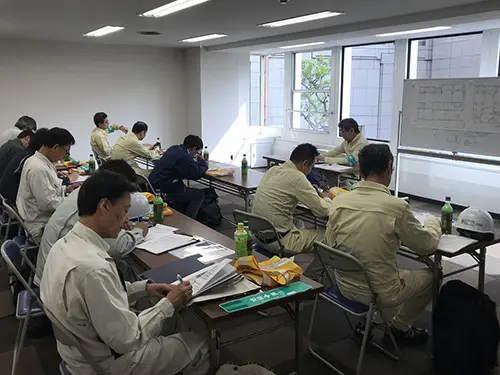
Seiwakai Safety Patrol Site Explanation
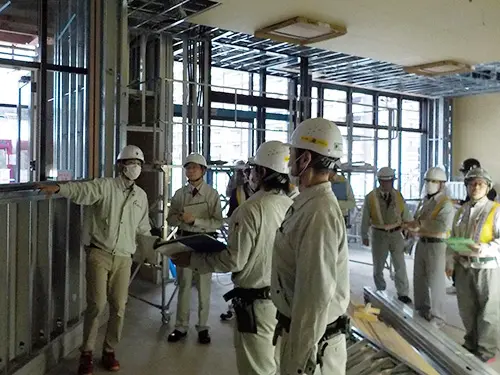
Seiwakai Safety Patrol
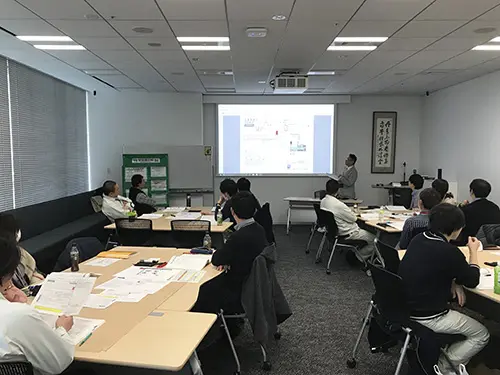
Disaster Prevention Council
Building a production base and responding to work style reforms
Through the operation of partnership systems and other initiatives, we are strengthening our network and trust with partner companies that support space creation, thereby enhancing our production base for sustainable business growth. In addition, we are improving productivity by streamlining on-site management tools through the introduction and utilization of DX, and by providing education and guidance to promote the linkage of BIM data with partner companies.
Furthermore, together with our partner companies that support over 6,000 projects annually, we are promoting solutions to serious labor shortages, environmental impact reduction, and work style reforms. We strive to ensure fair compensation through thorough negotiations, curb short-notice orders and sudden specification changes, and build a production base that encompasses coexistence and mutual prosperity, including "Tier N+1" beyond the multi-layered structure, by supporting BCP (Business Continuity Plan) development throughout the entire supply chain and advising on the introduction of telework.
Inclusive Procurement and DE&I Initiatives in the Supply Chain
We are committed to developing a sustainable production base and promoting DE&I (Development, Engineering & Integration) in our supply chain. As part of this effort, we have signed a Memorandum of Understanding (MOU) for a strategic partnership with FLOW, a BIM integration service provider. Leveraging the expertise of FLOW, where approximately 40% of its BIM employees are people with disabilities, we are promoting the creation of BIM data and the establishment of training systems for teams that include people with disabilities. We are working to expand the ordering and receiving of BIM-related work, as well as to create an environment where everyone can demonstrate their abilities, fostering diverse talent and creating employment opportunities.