




Site Search
Human Rights
- TOP
- Sustainability
- ESG Initiatives: S (Society)
- Human Rights
Tanseisha Group Human Rights Policy
Tanseisha Group Human Rights Policy
Basic Approach to Respecting Human Rights
The Tanseisha Group's Sustainability Policy, formulated in accordance with Purpose, states, "The Tanseisha Group is committed to continuously enhancing its corporate value and contributing to the realization of a colorful and sustainable society by addressing environmental and social issues through its business of creating valuable spaces and working diligently to resolve them. The company also states that it will "contribute to the realization of a colorful and sustainable society. In addition, the Tanseisha Group Code of Conduct states "Respect for Human Rights and Prohibition of Discrimination," and the Tanseisha Group will fulfill its responsibility to respect the human rights of all stakeholders involved in its business.
In formulating this policy, it was submitted to and approved by the Management Committee of Tanseisha and resolved at the Director meeting.
Tanseisha Group Human Rights Policy
- Compliance with international standards and laws related to human rights
We will conduct business activities based on the United Nations Guiding Principles on Business and Human Rights, and will support and respect international norms regarding human rights, such as the International Bill of Human Rights, the International Labor Organization's (ILO) Declaration on Fundamental Principles and Rights at Work, Children's Rights and Business Principles, and the Ten Principles of the United Nations Global Compact, while also complying with applicable laws and regulations in the countries and regions in which we conduct business.
Furthermore, when we are faced with a conflict between internationally recognized human rights standards and local laws, we will adhere to the higher standard and seek ways to respect international human rights standards. - Scope
This policy applies to all directors and employees of the Tanseisha Group (including seconded and temporary employees).
We also expect our business partners, including cooperating companies, and everyone involved in our business activities to understand, support, observe, and practice respect for human rights and diversity in accordance with this policy, and we aim to work together with them on this initiative. - Priority themes for respecting human rights
- Prohibition of discrimination and harassment
In order to respect human rights and diversity, we will not tolerate any discrimination, harassment or unfair treatment on the grounds of nationality, race, ethnicity, religion, ideology, sex, age, disability, gender identity, sexual orientation, employment status or any other reason. - Prohibition of child labor and forced labor
We will not engage in any form of child labor, forced labor, or human trafficking, nor will we engage in any human rights violations against foreign workers, etc. - Respect for fundamental labor rights
We respect fundamental labor rights, including freedom of association, as well as the right of workers to organize and the right to collective bargaining. In addition, we maintain and promote healthy and favorable labor-management relations through dialogue and discussion with employees or their representatives. - Appropriate payment of wages and management of working hours
In accordance with applicable laws and regulations, we will comply with the legal minimum wage and strive to pay a living wage or higher. We will also prevent long working hours and manage working hours appropriately. - Ensuring a safe working environment
We will consider the mental and physical health and safety of our employees, strive to create a comfortable and rewarding working environment, and ensure occupational safety and health. - Support for achieving work-life balance
We understand the importance of work-life balance for each employee, and we will promote initiatives that allow employees to choose from a variety of work styles to achieve both productivity and improved well-being. - Promoting Diversity, Equity & Inclusion (DE&I)
We will work to create a workplace and climate that respects different cultures, customs, and values, and strive to improve diversity so that each employee can grow and play an active role regardless of race, nationality, gender, etc. In addition, we will respect the human rights of vulnerable people who are easily alienated from society or whose human rights are violated, such as people with disabilities, foreign workers, and sexual minorities (LGBTQ, etc.), and work to support and provide relief for such people's independence. - Respecting the rights of indigenous peoples and local communities
We will respect the rights and cultures of indigenous peoples and local residents as stipulated in the laws and international agreements of the countries and regions in which we conduct our business. - Protection of personal information and respect for privacy
We will comply with relevant laws, regulations and other standards when handling personal information, and will work to protect the personal information and respect the privacy of all people involved in our business activities.
- Prohibition of discrimination and harassment
- Governance and Promotion Structure for Human Rights
Human rights initiatives are promoted mainly by the Sustainability Promotion Division, Human Resources and Labor Relations Division, and Supply Chain Management Division. The Sustainability Committee, chaired by President and Chief Executive Officer, is positioned within the governance structure. After regular discussion and deliberation, important matters are discussed and decided by the Executive Committee and reported to the Director meeting, thereby strengthening governance and reducing risk to management. - Human Rights Due Diligence Initiatives
We will establish a human rights due diligence system in accordance with the United Nations Guiding Principles on Business and Human Rights, identify any adverse impacts on human rights that may arise in the course of our business activities, and work to prevent and mitigate such impacts. - Corrective Actions and Remedies
If it becomes clear that the business activities of the Tanseisha Group have caused, contributed to, or contributed to adverse impacts on human rights, we will take appropriate measures to remedy or remedy the situation.
Furthermore, even if the Tanseisha Group itself does not directly contribute to adverse human rights impacts, if the Tanseisha Group's partner companies or other related parties are directly connected to adverse human rights impacts through their business, products or services, we will strive to prevent and mitigate those impacts.
We will set up a consultation desk through our corporate website etc. for all people involved in the business activities of the Tanseisha Group and operate it appropriately. With regard to reports and consultations received, we will thoroughly manage the privacy of the whistleblower and related parties and the information on the report, and protect the whistleblower from being treated disadvantageously as a result of having made a report. - Dialogue and consultation with stakeholders
We will continue to engage in dialogue and discussions with relevant internal and external stakeholders regarding the identification of actual and potential impacts on human rights and responses to improve them. - Education and Training
We will provide appropriate education and training to the directors and employees of the Tanseisha Group so that this policy is understood, established in our business activities, and effectively implemented. We will also promote activities to ensure that our business partners, including our cooperating companies, understand this policy. - Information Disclosure
We will disclose our human rights initiatives based on this policy on our corporate website and other means, and strive to ensure that our stakeholders understand them.
Established on February 1, 2025
President and Chief Executive Officer Osamu Kobayashi
Human rights management (human rights due diligence)
Based on the Tanseisha Group Human Rights Policy, we have begun human rights due diligence in 2025 to identify, prevent, and remediate risks to human rights that our group's business activities pose.
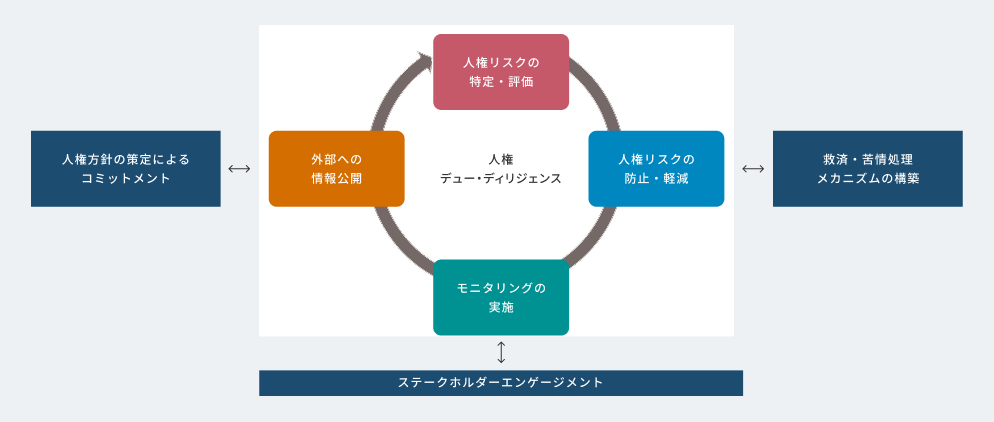
Promotion System for Respecting Human Rights
Our efforts to respect human rights are led by executive officers under the supervision of the "Sustainability Committee," chaired by President and Chief Executive Officer, and promoted in collaboration with relevant departments within the "Human Rights Subcommittee" (Sustainability, Human Resources and Labor, Supply Chain, etc.), as well as in cooperation with the company-wide "Risk Management Committee."
To address identified risks, we appropriately allocate necessary management resources (budget and personnel), including training for employees and business partners. This process and its progress are regularly reported to management meetings and the board Director to enhance the effectiveness of governance.
Human Rights Impact Assessment
In order to identify significant human rights issues that should be addressed as a priority, we conducted a human rights risk impact assessment for all of our businesses with the cooperation of Owls Consulting Group, an external human rights expert.
<Procedure for identifying and assessing human rights risks>
- Scoping
Focusing on the space creation business, which is the core business of our group, we divided the value chain into the phases of planning and proposal, design and production, procurement, sales, and use and consumption, and organized and grasped the overall picture. - Identifying human rights risk items
We comprehensively identified human rights risk items related to each stage of the value chain based on international human rights norms and industry-specific issues. - Conducting assessments for each human rights risk item
Based on interviews with relevant internal departments and the results of surveys of suppliers, we analyzed and assessed the importance of the issues from two perspectives: "Severity: the severity or seriousness of the adverse impact on human rights, the extent of the impact, and the inability to correct (difficulty of remediation)" and "Likelihood: the likelihood of the potential and actual risks occurring (frequency and possibility)." - Human rights risk mapping
We placed each risk item on a matrix diagram with the assessed "severity" and "likelihood" as the two axes, and organized it into a human rights risk map. We visually organized the major risks and prioritized specific corrective actions. We reported this to management and disclosed the results on our corporate website and elsewhere.
<Human rights risk map>
Among the high human rights risk items, we have identified those that we believe are particularly relevant to our business as items that require action. While continuing with the measures we have taken so far, we will promote efforts to reduce risks throughout our entire supply chain.
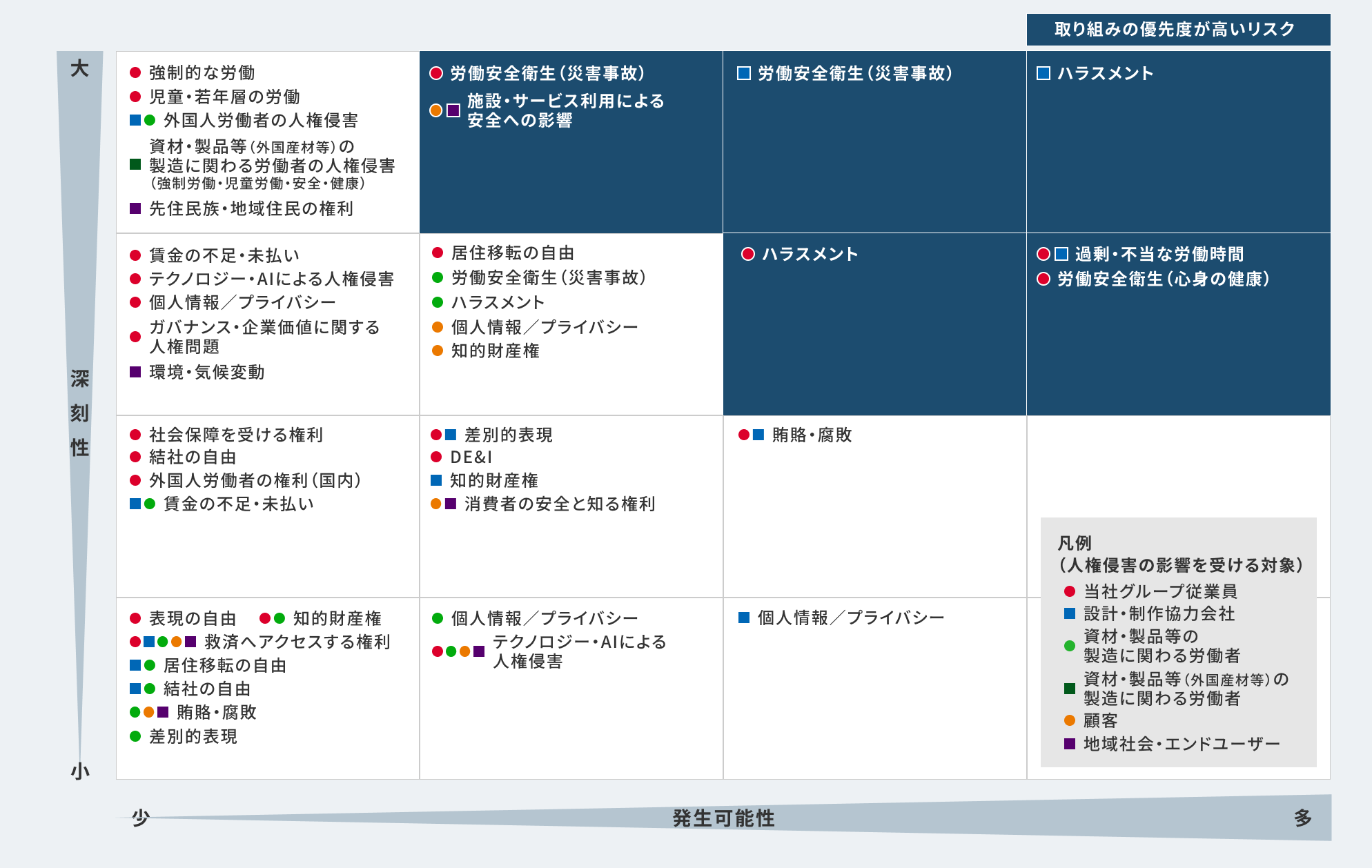
[Severity] The severity or seriousness of the adverse impact on human rights, the extent of the impact, and the inability to correct it (degree of difficulty of remediation)
[Likelihood of occurrence] Likelihood of potential and actual risks occurring (frequency and possibility)
Comments from external experts
Taking into account the characteristics of the business, the report broadly identified human rights risks across the entire value chain, from planning and design to Production, Construction, and operation, targeting a variety of spaces. This is an appropriate approach that is in line with the actual business situation. It is also important that the report focused on a variety of rights holders (those affected by human rights violations) and conducted an evaluation based on international standards. As demands on companies to address human rights grow, this type of response is an area that is directly linked to the sustainable growth and improved competitiveness of businesses. We look forward to continued steady efforts in the future. (Owls Consulting Group, Inc.)
Specific initiatives to address human rights risks
To address human rights risks that we have identified as particularly important and requiring action, we are implementing the following preventative and mitigation measures:
| Item | Human Rights Risk Overview | Examples of preventative/mitigation measures being implemented |
|---|---|---|
| Harassment | Various types of harassment against employees of our own group and employees of design and construction subcontractors, and the risk of inadequate response to such harassment | ・Establishment of internal and external consultation desks based on the "Harassment Prevention Regulations" and efforts to quickly resolve and correct problems - Establishment and operation of a "Compliance Hotline (internal reporting hotline)," a "Harassment Consultation Hotline," and a "Dialogue and Remedy Platform." - Thorough awareness-raising and situation assessment through e-learning-based "harassment prevention training" for all officers and employees, and the implementation of a survey to investigate the actual situation. |
| Excessive and unfair working hours | Risk of overwork and health damage due to inappropriate management of working hours, long working hours, and lack of breaks and holidays for our group companies and design and construction partner companies | - Real-time visualization of each employee's working hours through the implementation of an attendance management system. ・Utilize alert functions based on working hours and clock-in status, and have managers check as needed -Monthly confirmation of the occurrence of long working hours and progress of corrective measures ・Establishing a flexible work system by introducing telework, flextime, and short-time work systems ・Monthly meetings of the "Working Hours Improvement Committee," consisting of management and employee representatives - Encouraging the setting of construction periods that take into account the securing of holidays. - Model implementation of a shift system to ensure holidays |
| Occupational safety and health (mental and physical health) | Risks arising from inadequate safety and health measures and health management at business and workplaces | - Promotion of activities based on the "Safety and Health Management Regulations" ・Establishment of the Health Management Division as a dedicated department for health promotion - Implementation of "periodic health checkups," "stress checks," etc., based on the Industrial Safety and Health Act. ・Implementing "self-care learning" to learn knowledge and coping methods regarding one's own mental health care ・Promoting the creation of a workplace environment that is friendly to female employees and workers - Care provided in collaboration with industrial physicians and public health nurses for employees working long hours or those experiencing health problems. |
| Occupational safety and health (disasters and accidents) | Risks arising from inadequate safety and health measures at worksites and inappropriate responses to work-related accidents for employees of our own group and employees of construction subcontractors | - Promotion of activities based on the "Safety and Health Management Regulations" - Under the "Tanseisha Group Safety and Health Policy," we are committed to safe construction, high quality, and Environmental Consideration in cooperation with the group and partner companies. - Collecting information, coordinating, instructing and providing guidance to prevent occupational accidents among employees of our company and partner companies through monthly "Safety and Health Committee" meetings |
| Impact of using facilities and services on safety | Risks from a lack of inclusive design, health hazards from chemicals and building materials, and the loss of physical safety due to design and construction defects | ・Establishment of "Sustainable Design Guidelines" to realize a sustainable society and promotion of solving social issues through space creation - Adherence to the "Tanseisha Group Quality Policy," which serves as a guideline for providing appropriate quality and services. - Compliance with "Quality Technology Management Regulations," "Quality Technology Guidelines," etc. ・Through the "Tanseisha Safety Conference" and "Production Seminar," we raise awareness and provide various education programs regarding safety and quality control. |
Contact point for stakeholders to seek advice or report
| Classification | Reception details | Eligible users | Reception desk | How to file a complaint |
|---|---|---|---|---|
| Whistleblowing | Reporting and consulting on general compliance issues (regarding misconduct such as violations of laws and regulations or internal company rules) | - Officers and employees of business partners of each company in the Tanseisha Group - Executives, employees (including retired employees, contract employees, commissioned employees, as well as part-time and dispatched employees), and former employees (those who were employed within one year prior to the reporting) of the Tanseisha Group. |
External contact point (compliance hotline) | Telephone, email, fax, written communication, and in person |
| Internal (Audit and Supervisory Committee Member) | ||||
| <Within the Tanseisha Group> Risk and Compliance Office |
Telephone, email, fax, written correspondence, and in-person meetings (details will be provided on the company intranet). | |||
| Harassment counseling | Complaints and consultations regarding harassment | Tanseisha Group executives, employees (full-time employees, facility management employees, part-time employees), and temporary employees | Compliance Hotline (Whistleblowing Hotline) | Telephone, email, fax, written communication, and in person |
| <Within the Tanseisha Group> Wellbeing Promotion Department |
Telephone, email, fax, written correspondence, and in-person meetings (details will be provided on the company intranet). | |||
| Human rights violations (including harassment) | All issues related to human rights, including harassment (including environmental issues that can lead to human rights violations). | All stakeholders, including those listed above (including foreign workers of suppliers, rights holders such as human rights NGOs, and their representatives). | JaCER (Japan Association for Business and Human Rights Dialogue and Relief) | JaCER Complaint Reporting Form Japanese: https://jacer-bhr.org/application/index.html English: https://jacer-bhr.org/en/application/index.html |
Whistleblowing system
Compliance Hotline (Internal Reporting System)
The Tanseisha Group has established a reporting and consultation service based on the Whistleblower Protection Act. This service is for officers, employees (including retired employees, contract employees, commissioned employees, part-time employees, and dispatched employees), former employees (those who were employed within the past year prior to reporting), and officers and employees of business partners of the Tanseisha Group to report any misconduct, such as violations of laws and regulations or internal rules, that has occurred or is about to occur in relation to the business operations of the Tanseisha Group companies. A lawyer outside the Tanseisha Group has been designated to handle this service. We also accept consultations regarding whether a report is subject to reporting and other matters related to reporting. As a general rule, we accept reports and consultations made under real names. At your request, it is also possible to keep your name and other information confidential from the Tanseisha Group, allowing for "anonymity to the company." Furthermore, we also accept reports made completely anonymously, however in that case, we may not be able to conduct a thorough investigation of the facts or notify you of the investigation results. In addition, you will not be subjected to any disadvantageous treatment by the Tanseisha Group companies as a result of using this service.
Compliance Hotline
- Address: Ichigaya Legal Building 105, 4-1-5 Kudankita, Chiyoda-ku, Tokyo 102-0073
- Telephone number: 03-3239-5601
- FAX number: 03-3239-5651
- E-mail kasuga@kasuga-law.jpMAIL
- Attorney Michikazu Kunizuka
External whistleblowing hotline for human rights issues (dialogue and redress platform)
The Tanseisha Group has adopted the "Dialogue and Remedy Platform" of the "Japan Association for Business and Human Rights Dialogue and Remedy (JaCER)" as an external contact point for receiving reports from all stakeholders (including business partners and local communities) regarding cases where negative impacts on human rights occur or are likely to occur in business activities or supply chains.
We operate in accordance with the UN Guiding Principles on Business and Human Rights (UNGP), including ensuring the strict protection of whistleblowers' privacy and prohibiting any adverse treatment for reporting wrongdoing. We implement transparent problem-solving and remedy measures through dialogue with expert and neutral external organizations.
[Who can use this service?]
This service is available to all stakeholders (rights holders) involved in our business activities, including our group's officers and employees (regardless of employment status), our suppliers with whom we do business, and members of the local community.
[Cases covered]
You can report any business and human rights issues, including forced labor, child labor, excessive working hours, harassment, and occupational safety and health (accidents, physical and mental health).
[Response and relief process after receiving a report]
Our group will address the issue and provide relief to victims through the following process in response to reports made via JaCER.
- Appropriate corrective action and remedy depending on the case.
If an objective investigation confirms a negative impact on human rights, we will take strict action in accordance with the severity and circumstances of the case. At the same time, we will implement appropriate remedial measures tailored to each individual case to provide psychological care for the victims and to rectify and restore the harm they have suffered. - Feedback to the person who reported the issue
The progress of the investigation and the results of the response will be disclosed as appropriate through the JaCER platform, while strictly protecting the anonymity and privacy of those who reported the incident. We aim to resolve the issue through transparent communication and dialogue. - Post-implementation follow-up and continuous improvement
Even after corrective and remedial measures are completed, we will conduct follow-ups after a certain period to confirm that the measures taken are functioning effectively and that no adverse treatment (such as retaliatory actions) has occurred against the person who reported the incident. We will strive for continuous improvement to prevent recurrence and respect human rights.
JaCER Complaint Reporting Form
Building sound labor-management relations and fair treatment
Labor-management dialogue and improvement of working conditions
The Company has established one of the Group Code of Conduct as "Respecting freedom of association and basic labor rights, including workers' right to organize and the right to bargain collectively," and conducts management that respects human rights. The company adopts the union shop system, and 100% of the employees subject to the collective agreement are members of the employee union.
Once a month, we hold a Management Council with the employee union to explain to the employee union management policies, management plans, and overall company-wide performance, as well as discuss working conditions such as working hours, holidays, vacations, and working conditions, standards for wages and bonuses, improvement of health and safety, management of welfare programs, education, training, and career development, etc., and strive for mutual understanding, communication, and coordination of opinions between labor and management. In addition, apart from the Management Council, the Committee for Improving Working Hours, etc., is held every month with the participation of management and employee representatives to discuss ways to ensure good working conditions.
Operation of wage and evaluation systems
Wages are determined by linking three systems: a "grading system" based on the standard of expected roles, an "evaluation system" based on actions and results, and a "compensation system" based on company performance, discussions with employee unions, and regulations. In addition to the monthly salary, wages under the compensation system are paid to employees as "bonuses" twice a year in principle.
In addition to ensuring wage levels above the statutory minimum wage, we are working to establish a system to eliminate unreasonable disparities in treatment based on gender and employment status in accordance with the provisions of the Part-time and Fixed-Term Employment Labor Act, the Worker Dispatch Act, etc.
Wage increases are implemented based on responses to price increases and consultations with employee unions.
Furthermore, in order to enhance the objectivity and credibility of our evaluations, we implement the following measures:
- • [Dissemination of Salary Regulations] Thorough dissemination of wage systems, salary increases/decreases, and promotion/decreasing criteria to all employees.
- • [Clarification of evaluation criteria] Clearly define evaluation items and criteria to ensure fair evaluation.
- • [Implementation of Feedback Interviews] Annual interviews with supervisors regarding evaluation criteria and results for all employees.
- • [Review of continued appointment of managers] Implementation of a review of continued appointment of managers based on certain evaluation criteria.
- • Distribution of the "Performance Evaluation Guide": Clarification of evaluation criteria and dissemination of information about a fair evaluation process.
- • [Providing guidance and training to evaluators] Guidance on the importance of performance evaluation, prevention of discrimination and bias based on attributes, and methods for providing fair evaluation and skill development opportunities.
In addition, we have established systems such as the President's Award and departmental awards to recognize employees and teams that serve as role models for other employees.
Promoting recruitment that respects human rights
Our company complies with international norms and laws regarding human rights and labor, and conducts transparent recruitment processes that respect the fundamental human rights of applicants. To eliminate unfair discrimination and human rights violations, we are committed to the following:
- • [Disclosure of Recruitment Policy and Selection Process] We will disclose our selection criteria, which are based on respect for fundamental human rights and aptitude and ability, and will also disclose the recruitment and selection process to job seekers through our official website, etc.
- • [Consideration for Web Accessibility] Ensuring information accessibility by building the recruitment site in accordance with JIS X 8341-3:2016.
- • [Thorough Prevention of Discrimination in Selection Processes] Based on the Ministry of Health, Labour and Welfare's "Basic Principles of Fair Recruitment Selection," guidance and training on respecting and considering human rights are provided to interviewers to ensure they do not discriminate based on race, religion, nationality, place of origin, gender, educational background, etc.
- • [Compliance with International Labor Standards (Prevention of Child Labor and Forced Labor)] Prevention of child labor through proper age verification using official documents at the time of hiring, and thorough implementation of prior presentation of working conditions and agreement based on the individual's free will (prevention of forced labor).
Human rights awareness and training
We provide sustainability training (e-learning) to all executives and employees of the Tanseisha Group, including information on sustainability in general.In particular, regarding "human rights," a theme particularly relevant to our group's business, we incorporate appropriate content into the training to ensure that the Tanseisha Group Human Rights Policy is understood, embedded in business activities, and implemented effectively.We also provide separate training specifically on the themes of "compliance" and "harassment."
Initiatives to respect people in creating spaces
We have developed the "Sustainable Design Guidelines," which outline our efforts to promote "sustainable design," a design methodology for realizing a sustainable society, and are working to solve social issues through the creation of a variety of spaces.
Sustainable Design [Respect for People]
- (1) We provide a space that "moves hearts" by deepening understanding of a diverse range of users.
- (2) We will consider ways to make the space easy to use and safe for everyone to experience.
- (3) We strive to maximize people's well-being through creating spaces.
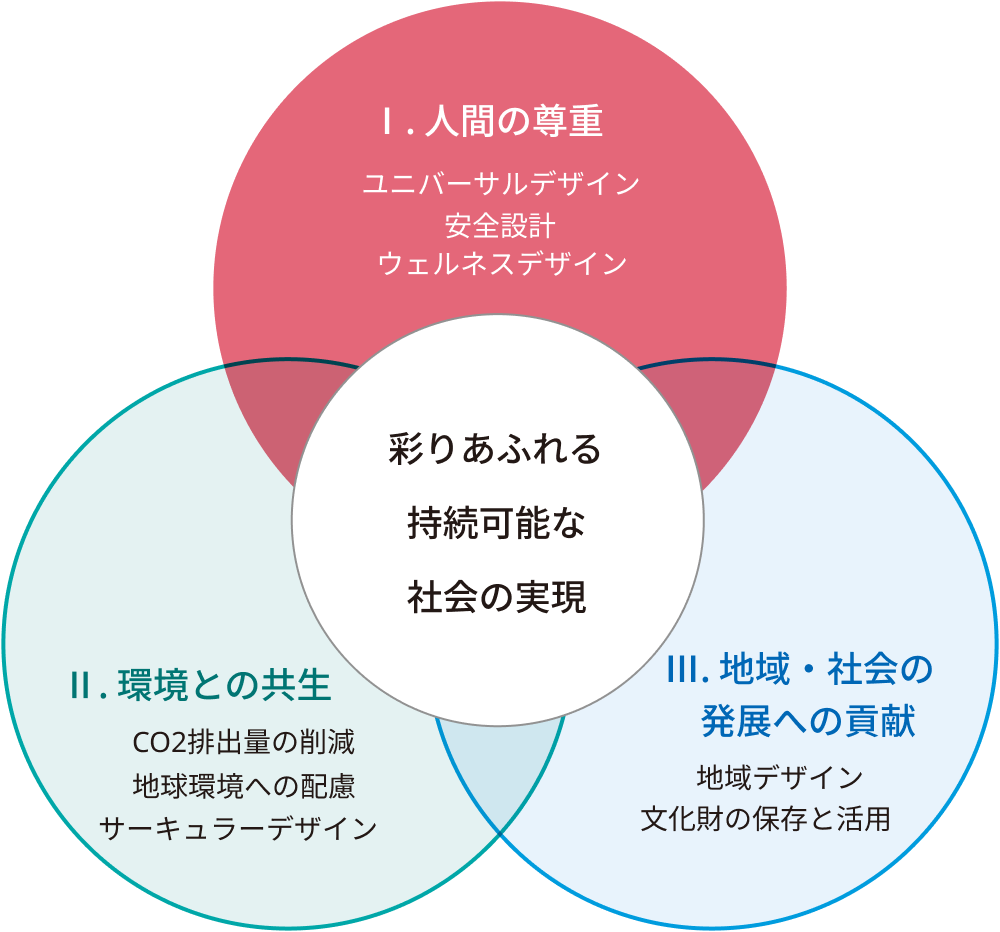
Initiative Themes
(1) Universal design (2) Safety design (3) Wellness design
Promoting Universal Design
In addition to universal design in terms of both soft and hard aspects, we strive to practice "universal design of the heart."
Since 2018, we have partnered with Mirairo Co., Ltd., a company that specializes in universal design consulting, to create facilities that incorporate universal design.
In addition, we have developed a multilingual app called "T-VOIX" that uses UV codes * to provide information translated into various languages in text and audio in offline environments, and we are working to have this app adopted by cultural facilities throughout Japan.
Additionally, we are continually collecting information about universal design and sharing it on our company intranet.
UV code: Uni-Voice, a speech code developed by the Japan Association for Visually Impaired Information Service (JAVIS), a non-profit organization.
Examples of achievements
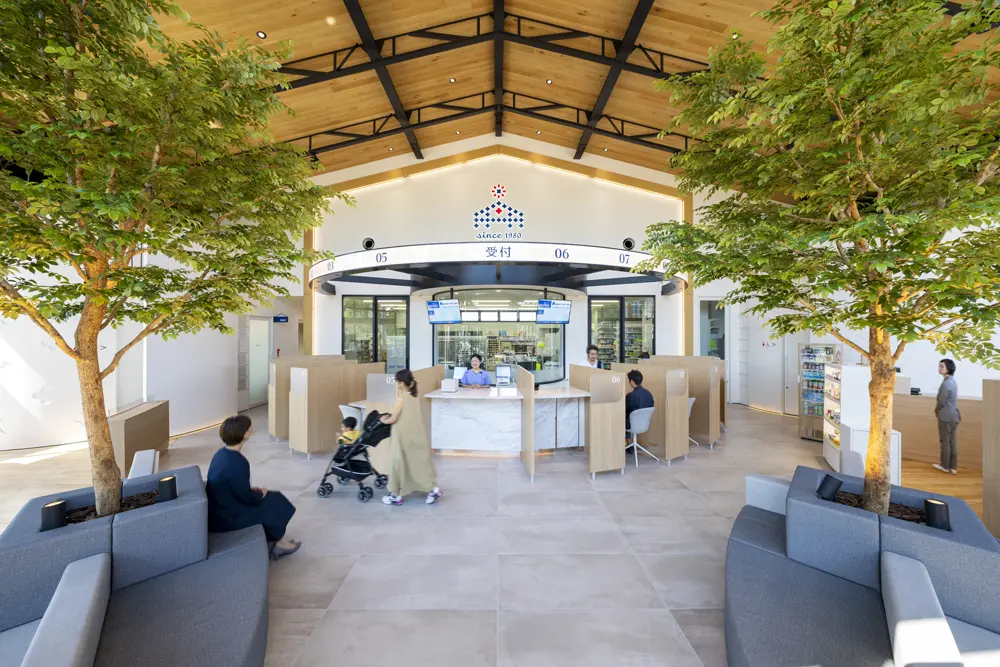
"Ikei Pharmacy Yanaka Store"
Together with Mirairo Co., Ltd., a universal design consulting company, we carried out on-site surveys and verifications, aiming to create a space that took into consideration the width of the aisles, the wheelchair space in the waiting area, the dimensions and shape of the prescription counter, and the location of assistants. In addition, in the lobby, we placed bookshelves that also function as partitions at a height that can be easily used by people of all ages, from children to the elderly. In the sales corner, we also installed a counseling counter and beauty salon booths to help people become truly healthy.
(Owner: Sun IM Planning Co., Ltd. | Scope of work: architectural and interior Basic Planning, design, Basic Layout, logo and business card design, Total Design supervision, furniture, store signs, and tower clock construction)
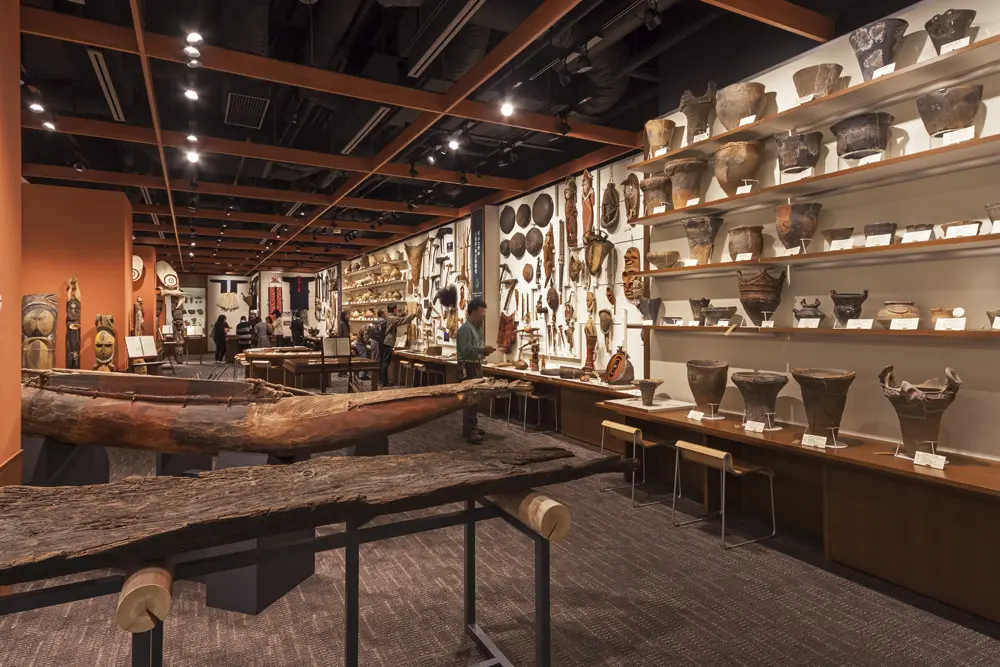
Nanzan University Museum of Anthropology
A museum where you can touch and enjoy all the exhibits
Learn more

Mt. Fuji World Heritage Centre, Shizuoka
Implementing Video composition using only images without narration or subtitles
Learn more
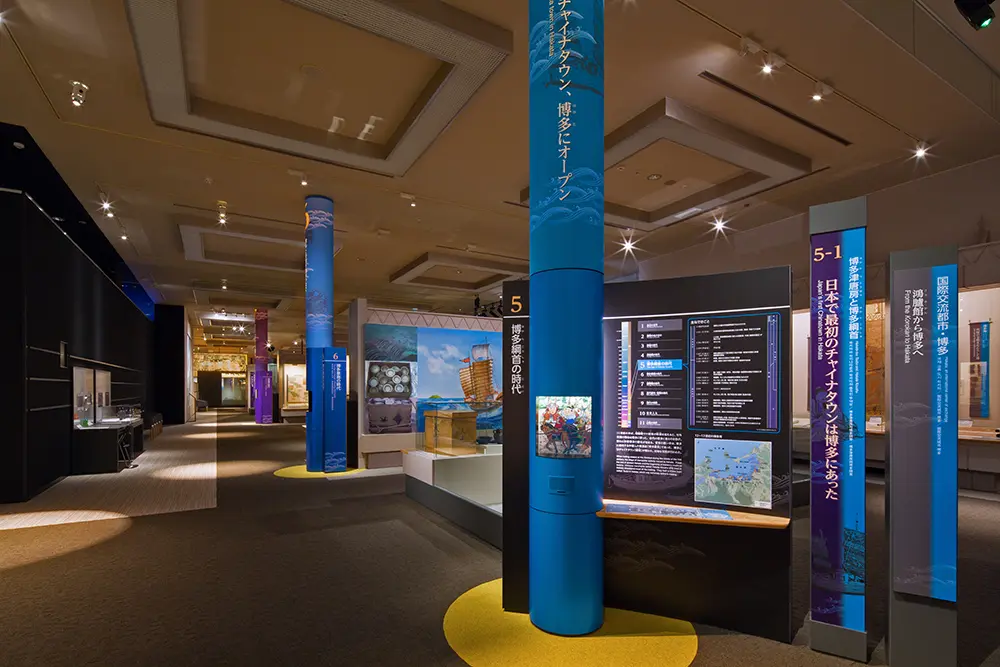
Fukuoka City Museum
A universal museum that is easy for everyone to use and understand
Learn more
Related Information | Our Website "Announcements"
Photography: Nacása & Partners Inc., Forward Stroke inc., ss kikaku, Kawakami Photo Studio, Daichi Misono, and others