




Site Search
Materiality
- TOP
- Sustainability
- Materiality
Materiality Assessment
Tanseisha has identified six materialities in its sustainability efforts and is promoting initiatives to address them throughout its corporate activities. The materialities are reviewed periodically in response to changes in the company’s and society’s circumstances, and the current materialities were re-identified in February 2024.

Respect for humanity

Coexistence with the environment
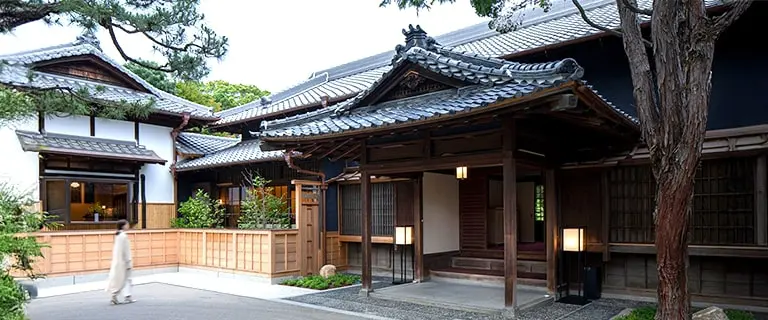
Contribution to regional and social development

Promotion of innovation

Development of a responsible supply chain
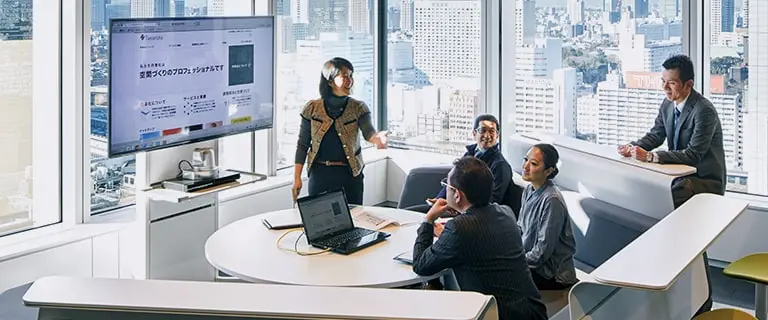
Enhancement of corporate governance
Materiality Assessment and Review Process
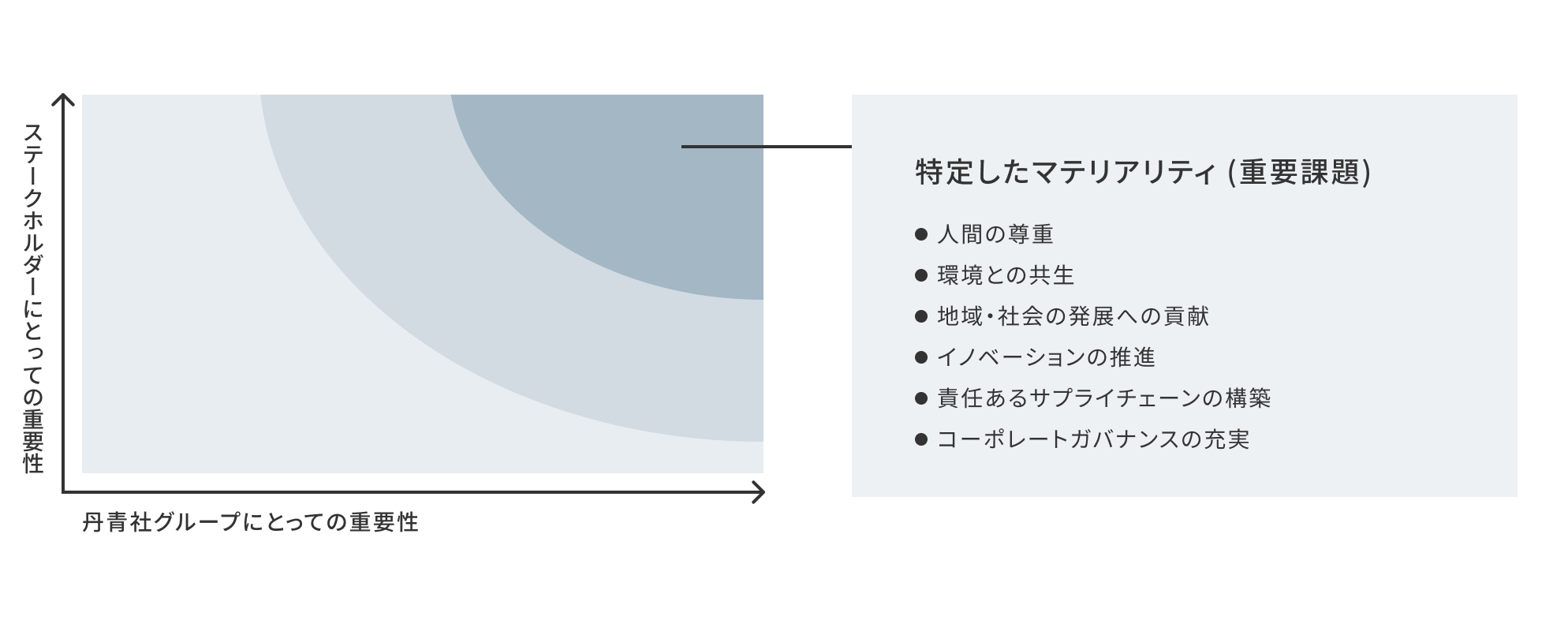
In 2019, the Tanseisha CSR committee, headed by our company president, assessed the importance of issues we face as a company using the following steps, the results of which were concluded by management and executive meetings. In conjunction with the formulation of “Our Purpose” and “Vision 2046” in February 2024,we reviewed and re-identified our materialities in light of the latest environmental awareness.
- STEP 1:
Addressing societal issues. - We selected forty-five societal issues to address based on our company principles, our experience in an array of corporate projects, our CSR efforts and by following the guidance provided by ISO26000 and the United Nation’s SDGs.
- STEP 2:
Assessing importance of issues. - We analyzed, organized and summarized the importance of each issue from both our stakeholder’s point of view and our own, i.e., The Tanseisha Group. Furthermore, insights and opinions were exchanged with out-of-house executives.
- STEP 3:
Pinpointing materiality. - We concluded the top six issues that both stakeholders and Tanseisha Group companies prioritize.
- STEP 4:
Reviewing and re-identifying materialities. - We reviewed our materialities and re-identified six materialities in conjunction with the formulation of “Our Purpose” and “Vision 2046” in February 2024, together with the reassessment of the materiality of societal issues.
Promoting sustainable design based on materiality
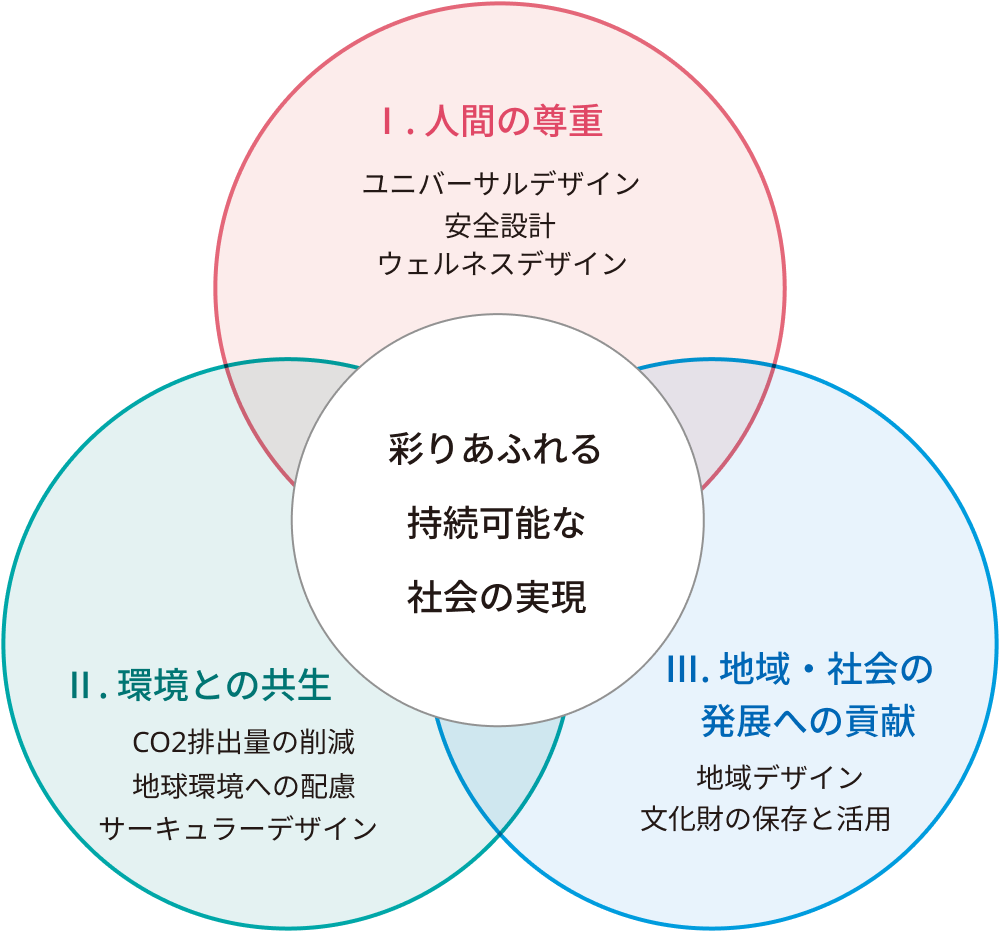
Tanseisha Group's designers implement "sustainable design," a design method to realize a sustainable society, and aim to realize a colorful and sustainable society.
The important issues (materiality) set by Tanseisha were interpreted from the perspective of sustainable design, and eight themes directly linked to spatial design - "respect for people," "coexistence with the environment," and "contribution to the development of the local community and society" - were selected. Linked to these, the eight themes of Preservation Planning cultural assets."
Materiality and KPIs
Tanseisha sets KPIs and targets for materiality (important issues) in its sustainability efforts, and also determines priority targets for the SDGs, and promotes initiatives to address these.
| Respect for people We respect human rights and diversity, and pursue human happiness. We provide spaces and experiences that move the hearts of diverse users, and we create an organizational culture where diverse employees respect each other and utilize their various perspectives, knowledge, and know-how, and an environment where each individual can grow and thrive. |
||||
| 2026 KPI | FY2026 target | Initiatives for Fiscal Year 2025 | SDGs Priority Goals/Major Initiatives and Directions | |
|---|---|---|---|---|
| 1. Providing spaces and experiences that move the hearts of a diverse range of users | Information dissemination and awareness-raising facilities | Implementation of initiatives | Promoting achievements such as the Taito City Shitamachi Museum, Aoyama Gakuin Museum, the International Red Cross and Red Crescent Movement Pavilion at the Osaka-Kansai Expo, and the Gas Pavilion Ghost Wonderland at the Osaka-Kansai Expo. | In his main business of creating spaces, he plans and designs information dissemination and awareness raising on a variety of themes. |
| Proposing and implementing safety and wellness designs | Monitoring the planning and implementation of sustainable design (Respect for People (2) Safety Design (3) Wellness Design) | Development of "Sustainable Design Guidelines" and implementation of training to promote the guidelines. | Create a safe and secure space. |
|
| Proposing and implementing universal design | Monitoring the planning and implementation of sustainable design (Respect for People (1) Universal Design) | Development of "Sustainable Design Guidelines" and implementation of training to promote the guidelines. | We will create inclusive spaces that take into consideration a variety of users, including people with disabilities and the elderly (practicing universal design). |
|
| 2. Creating an organizational culture where diverse employees respect each other and utilize their diverse perspectives, knowledge, and know-how | Diversity training | Once a year (for eligible individuals) | Once a year (106 participants) | We will work to foster education, awareness-raising and a culture that understands and accepts diversity and encourages diverse employees to demonstrate their capabilities. |
| Ratio of female managers | 15% | 11% | In addition to employing diverse talent, including women, the elderly, and people with disabilities, we will also take steps to increase the job satisfaction of diverse employees. |
|
| Engagement Score | Rating higher than previous year | 53.9 points (up 4.3 points from the previous time) | ||
| 3. Creating an environment where each individual can grow and thrive | Formulating a company-wide education plan | Formulating a company-wide education plan | Review of the company-wide training system | Provide continuing education opportunities for employees to support their growth. |
| Establishment of specialized education | Establishment of a specialized education system for design and production positions | Review of the specialized education system | ||
| Career interviews | Implementation rate: 100% | Implementation rate: 93.5% | ||
| Taking a health checkup | 100% consultation rate | Consultation rate: 99.7% | ||
| Taking paid leave | Acquisition rate 100% | Mandatory annual paid leave of 5 days: 100% utilization rate (utilization rate relative to granted days: 57.1%) | ||
| fatal accident | 0 items | 0 items | ||
| Number of employees who meet the company's working hour standards | Increased from the previous year | We conduct monthly monitoring to confirm an improving trend. | ||
| Coexistence with the environment We will address environmental issues such as global warming, loss of biodiversity, and resource depletion, and contribute to the realization of decarbonization, coexistence with nature, and a circular economy by working to address these issues throughout all of our corporate activities. |
||||
| 2026 KPI | FY2026 target | Initiatives for Fiscal Year 2025 | SDGs Priority Goals/Major Initiatives and Directions | |
| 1. Addressing environmental issues such as global warming, loss of biodiversity, and resource depletion | Environmental education | 1 time/year | 1 session (Sustainability training) | Contribute to the realization of a circular economy by promoting waste reduction, reuse, and recycling in the space creation business. |
| Initiatives to improve recycling rates | Creating a roadmap | Improving the sorting rate of industrial waste at the site (67.2% / Target 70% *m3) | ||
| Waste reduction practices | Implementing waste reduction initiatives | Prior consideration of reducing industrial waste generation (91.5%) | ||
| Serious environmental accidents | 0 cases/year | 0 items | We will thoroughly implement proper management of waste materials such as chemical substances. |
|
| 2. Contribute to the realization of decarbonization, coexistence with nature, and a circular economy | Proposing and implementing environmentally friendly projects | Monitoring the planning and implementation of sustainable design ([Coexistence with the environment] (1) Reduction of CO2 emissions (2) Consideration for the local environment (3) Circular design) | Development of "Sustainable Design Guidelines" and implementation of training to promote the guidelines. | We practice Environmental Consideration design (sustainable design) in our space creation business. |
| Scope 1 and 2 greenhouse gas emissions | 40% reduction compared to base year (2021) | Reduction rate 59.1% | Reduce greenhouse gas emissions associated with business activities (energy-saving initiatives, etc.). |
|
| Greenhouse gases including Scope 3 | Implementing reduction initiatives | Expanding the scope of CO2 emission calculations to all group companies and businesses. | ||
| Contributing to the development of local communities and society We will contribute to the development of local communities and society by encouraging rich interactions between people, revitalizing industry and economic activity, and creating, disseminating, and passing on diverse and rich cultures. |
||||
| 2026 KPI | FY2026 target | Initiatives for Fiscal Year 2025 | SDGs Priority Goals/Major Initiatives and Directions | |
| 1. Promoting rich interactions among people 2. To stimulate industrial and economic activity, and to create, disseminate, and pass on diverse and rich cultures. |
Proposing and implementing projects that contribute to regional revitalization | Monitoring the planning and implementation of sustainable design guidelines ([Contribution to regional and social development] (1) Regional design) | Development of "Sustainable Design Guidelines" and implementation of training to promote the guidelines. | Through our space creation business, we solve our customers' problems and contribute to adding value and improving economic productivity by creating a lively atmosphere. |
| Through our space creation projects, we aim to create places that will serve as regional hubs (regional revitalization) and contribute to sustainable Tourism. |
||||
| Proposing and implementing projects that contribute to the utilization and preservation of cultural assets | Monitoring the planning and implementation of sustainable design guidelines (Contribution to regional and social development (2) Utilization and preservation of cultural assets) | Development of "Sustainable Design Guidelines" and implementation of training to promote the guidelines. | We contribute to the preservation and inheritance of history, culture, and nature through our spatial creation projects. |
|
| Promoting innovation We will respond to social changes and technological advances, constantly learn, and proactively engage in various research and development and demonstration experiments. We will continue to take on the challenge of creating new value through the development of new services and businesses. |
||||
| 2026 KPI | FY2026 target | Initiatives for Fiscal Year 2025 | SDGs Priority Goals/Major Initiatives and Directions | |
| 1. Respond to social changes and technological advances, and continue to learn 2. Actively engage in various research and development and demonstration experiments 3. We will take on the challenge of creating new value through the development of new services and businesses. |
Promoting R&D activities that contribute to innovation in spatial experiences | Promoting ongoing activities | Development of new solutions for real-world and digital spaces, implementation of industry-academia collaborative projects. | We will pursue innovation by working to create various added value, including utilizing technology.
|
| Implementation of new technologies into projects | Promoting ongoing activities | VisualTiles® project implementation, FAC+ project implementation | ||
| Nurturing young talent to contribute to innovation in spatial experiences | Implementing independent practice projects led by young people | "Super Cultural Festival" held (Participants: 505 people *including those in Kansai and both inside and outside the company) | ||
| Creating projects that incorporate cutting-edge knowledge and technology | Project Creation | A collaborative project to regenerate small-diameter timber into high-value building materials has been launched, and the spatial data analysis service "COCOSTAT" has been released. | ||
| Building a responsible supply chain By expanding our network and building relationships of trust with our cooperating and partner companies, we will build a foundation for value creation, including quality and safety, and address sustainability issues such as the environment and human rights throughout our supply chain. |
||||
| 2026 KPI | FY2026 target | Initiatives for Fiscal Year 2025 | SDGs Priority Goals/Major Initiatives and Directions | |
| 1. Expand our network with partner companies and build relationships of trust, creating a foundation for value creation that includes quality and safety. 2. Addressing sustainability issues such as the environment and human rights throughout the supply chain |
Achievement of new developments by partner companies | 100% | Implementation of monitoring of the adequacy of partner companies | Address a wide range of sustainability issues across the entire supply chain. |
| Training for partner companies | Production: 2 times/year Design: Once a year |
Implementation of training (1 session) to promote the adoption of sustainable procurement guidelines. | ||
| Awards for partner companies | 1 time/year | Implemented by the department for production partner companies. | ||
| Enhancement of corporate governance We will adapt to changes in society, always pursue the best corporate governance, and continually work to improve it. We will ensure transparency and fairness in decision-making, maintain high ethical standards as a company, and remain a company that is widely trusted by society. |
||||
| 2026 KPI | FY2026 target | Initiatives for Fiscal Year 2025 | SDGs Priority Goals/Major Initiatives and Directions | |
| 1. Adapt to changes in society, always pursue the best corporate governance, and continually work to improve it. 2. Ensure transparency and fairness in decision-making 3. Maintain high ethical standards as a company and remain a company that is widely trusted by society |
Third-party evaluation of the effectiveness of the Board Director | 1 time/year | 1 time | - (not set) |
| Dialogue with shareholders | Over 80 IR meetings per year | 114 IR meetings per year | ||
| Compliance training | 1 time/year | 1 time | ||
| Establishment and improvement of reporting channels | Introduction of a dialogue and relief platform | Considering the introduction of a new external reporting hotline. | ||
| Strengthening information disclosure | Establishment of sustainability information disclosure in line with international standards | Information gathering for disclosure | ||
Tanseisha will set priority targets for the SDGs based on the materiality (important issues) of our sustainability efforts and will promote efforts to address these targets.
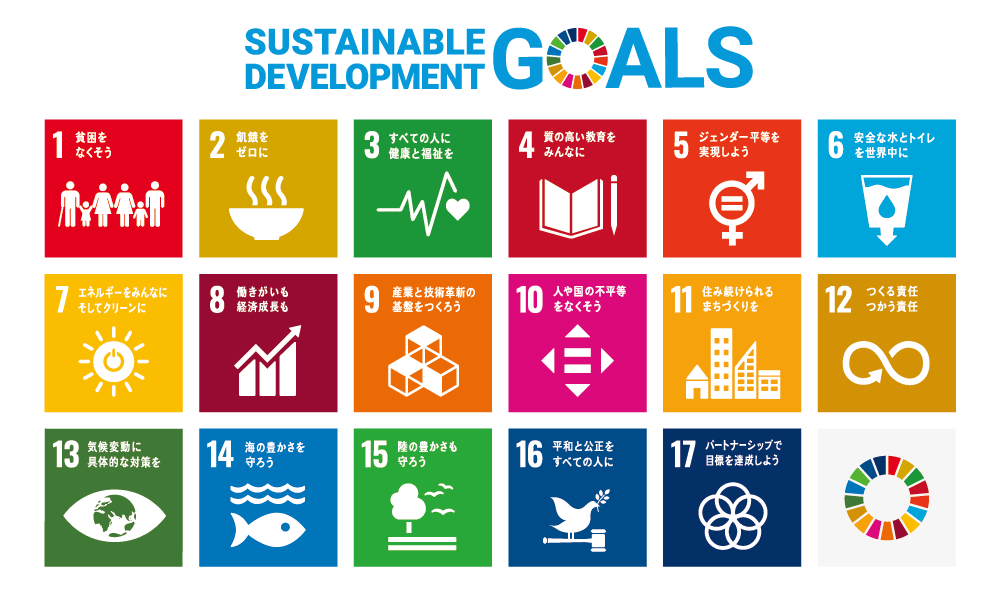
What are the SDGs (Sustainable Development Goals)?
The SDGs (Sustainable Development Goals) are international goals adopted at the United Nations Summit in September 2015, aiming to create a sustainable and better world by 2030. They consist of 17 goals and 169 targets, and pledge to "leave no one behind" on the planet. Tanseisha will contribute to achieving the SDGs by addressing materiality (important issues).