





Tanseisha released the results of a survey on museum usage trends on Tuesday, December 23, 2025.
*The museums surveyed this time refer to facilities such as museums, art galleries, science museums, zoos, aquariums, and botanical gardens that have a "system of knowledge" and whose exhibition methods are primarily focused on "learning."
Purpose of the survey
This survey was conducted with the aim of understanding the latest trends and attitudes regarding current museum usage, as people's values and leisure time habits continue to change.
The recent rise in prices has led to increased cost consciousness, which is limiting users' range of activities while accelerating the trend toward emphasizing "time performance" (Taipa), which seeks to maximize satisfaction with limited time and money. Against this social backdrop, this survey will shed light on the correlation between users' psychology and behavior, showing what elements they find "high added value" in and decide to visit, even as they prioritize "nearby" facilities.
Specifically, by conducting a multifaceted analysis of the actual state of information gathering that leads to museum visits, we aim to consider what kind of museum modern users want, and to obtain basic information that can serve as a guide for future facility management and effective information dissemination that is in line with the target lifestyles.
Survey results summary
With rising prices causing a quarter of fans to reduce their visits, the trend is to "return to local venues" by cutting back on travel expenses and touring nearby venues. While the "official website" is the most trusted source of information across all generations, there are also signs of new technology, such as AI generation, which is a trigger for people in their 20s. There is a clear trend toward "types" that combine efficiency and quality.
Below is a page listing all the survey results.
Survey results page: https://www.museum.or.jp/static/museumfanresearch2025
1) Impact of rising prices on museum visit frequency
-To what extent do recent rising prices (rising living and transportation costs, etc.) affect how often you visit museums?

-Comparison of the amount spent per museum visit and frequency of visits
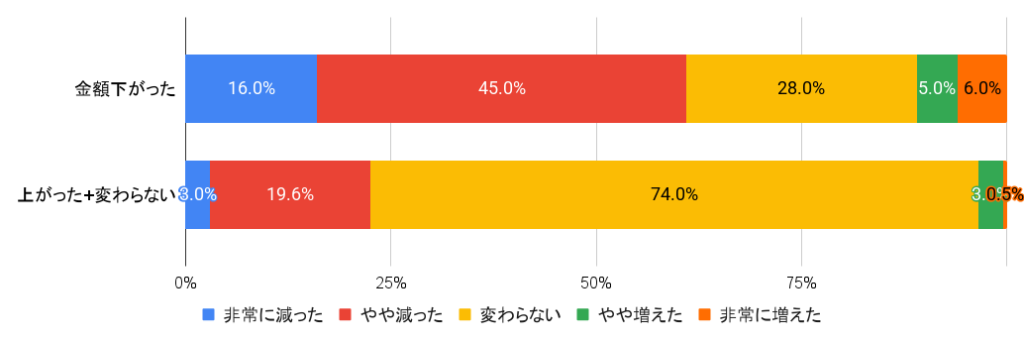
[Explanation]
The recent rise in prices has also affected the frequency of museum visits, with 26.0% of people saying their visits have "reduced significantly" or "decreased somewhat." This indicates that just over a quarter of fans are actually reducing the number of visits they make.
●On the other hand, when broken down by expenditure amount, 61.0% of those who "declined in spending" have reduced their frequency of visits, while only 22.6% of those who "stayed the same or increased in spending" did the same. People who don't spend money are no longer going, while those who spend are undeterred, and rising prices are leading to a polarization between "thrifty people" and "fans."
2) The relationship between changes in expenditures and saving behavior
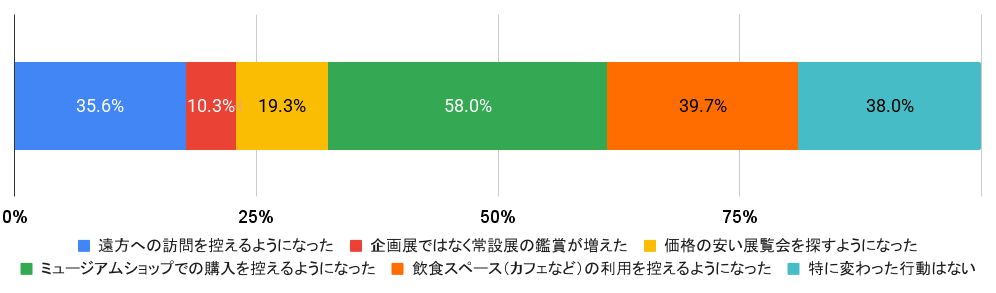
-Have you consciously changed your behavior when visiting museums compared to before in order to reduce costs? (Overall)
-Comparison of saving behavior and visit opportunities
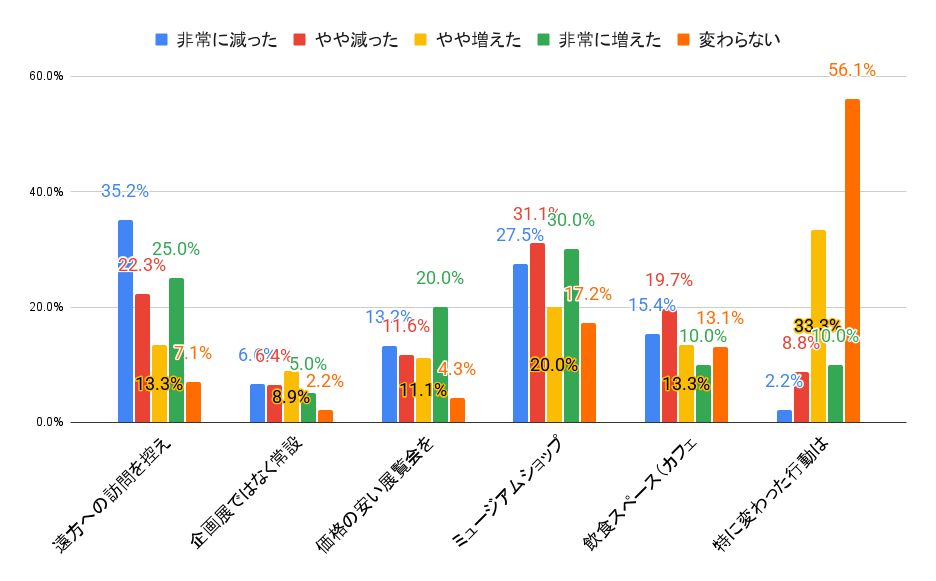
[Explanation]
●When asked about conscious actions to cut costs, the top answer was "reducing purchases at shops (58.0%)" and the second was "reducing eating and drinking (39.7%)." There is a clear tendency to cut spending on accompanying services first, rather than on the art itself.
●When looking at visit frequency, the response "refrain from visiting distant places" was high not only among those whose frequency had dropped dramatically (1st place), but also among those whose frequency had increased dramatically (2nd place).
●Those on a tight budget are cutting travel expenses and reducing the number of visits they make, while active people are cutting back on the cost of each trip and using that money to visit nearby facilities, making a strategic move toward a "local shift."
●As a result, it can be said that both groups are converging on an appreciation style of "cutting travel costs and enjoying art in the local area."
3) The relationship between generative AI and museum visits
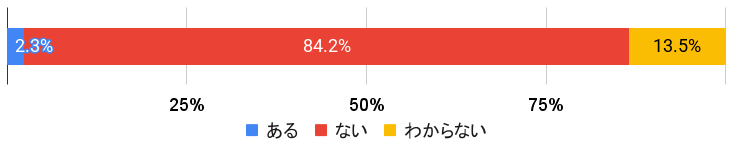
- Has the use of generative AI ever led to a museum visit? (Overall)
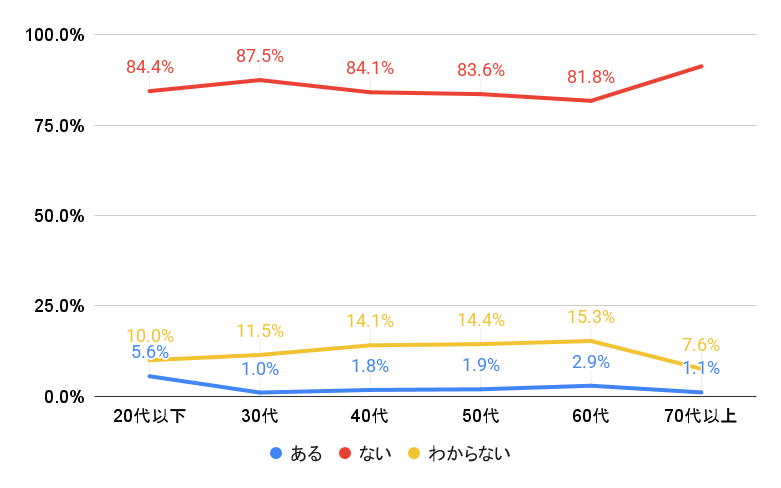
- Comparison by age group
[Explanation]
●When asked if the use of generative AI had led to visits, 84.2% answered "no," meaning that there is currently little visible direct impact.
However, by age group, those in their 20s and under stand out at 5.6%, while other generations only account for 1-2%. While still a minority overall, the figure of about five times that of other generations is a small sign that younger generations are shifting from traditional search methods to interactive AI search methods.
4) Media that motivates people to visit museums
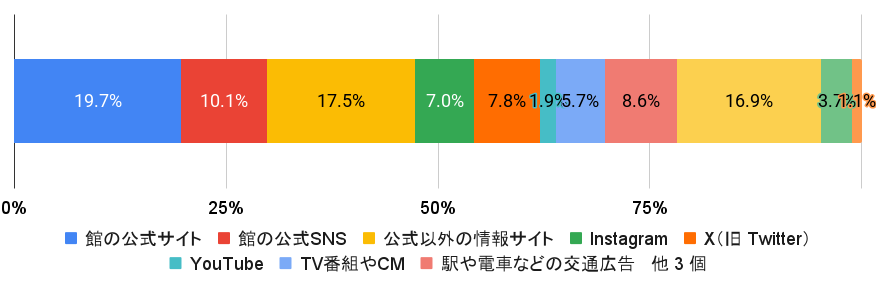
・What motivates you to go to museums? (Overall)
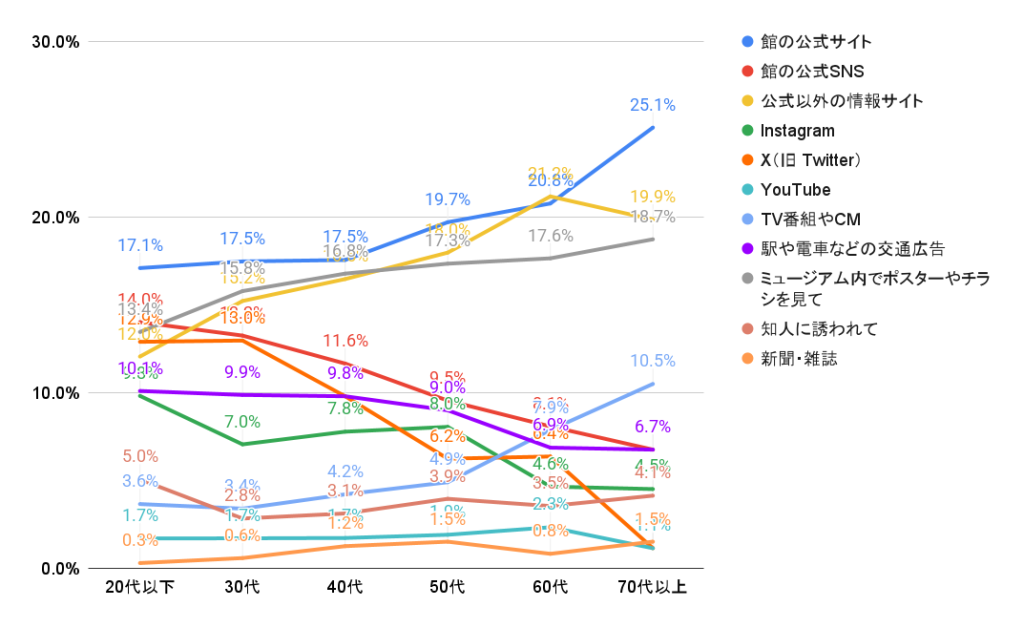
- Comparison by age group
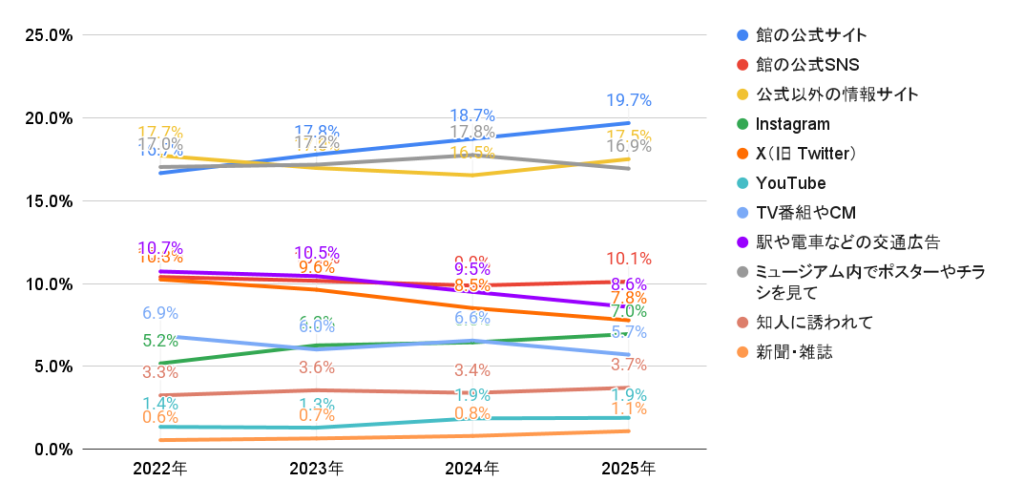
・Comparison over time (2022-2025)
[Explanation]
The top three reasons for visiting a museum are the museum's official website (19.7%), non-official information sites (17.5%), and in-museum posters and flyers (16.9%), with these being the main contact points.
●By age group, there is a bias towards the use of social media, television, and posters, but the "official museum website" alone maintains a high usage rate of 17-25% across all generations. This shows that the official website functions as the "most reliable source of information" for all age groups.
Over the past four years, the number of museum official websites has been steadily increasing, reaching a record high in 2025. In the digital age, official websites are the most powerful motivation for visitors.
[Overall commentary]
While large-scale exhibitions were a big success this year, rising admission fees and related costs have led to museums becoming more of a place to be "visited with careful consideration." Visitors are increasingly using the internet, particularly reliable "official websites," to thoroughly research information and become convinced before visiting. Furthermore, the impact of rising prices is not limited to simply refraining from purchasing; instead of traveling far and reducing travel costs, a new trend of "going local" is taking hold, with people visiting nearby facilities multiple times. More than ever, museums are being called upon to deliver accurate, high-value-added information to this demographic, which seeks to balance style with cost-effectiveness.
■ Commentator: Mikio Furukawa (Editor-in-Chief of IM/Tanseisha Business Development Headquarters)

Born in Ehime Prefecture in 1966. Joined TANSEISHA Co., Ltd. in 1990. Engaged in spatial design at the Head Office Design Center and JDN Co., Ltd., as well as launching and operating owned media. Has been in his current position since 2011. He continues to cover approximately 200 museums per year.
"In this age of information overload, IM hopes to be the most sincere bridge connecting museums and fans."
<Survey Overview>
Survey period: November 25, 2025 to December 8, 2025
Survey target: IM members
Number of valid responses: 1,115
Survey method: Internet survey
※<Please include credit when quoting or reprinting>
When reprinting the contents of this release, please use the spelling "IM."
■ What is "IM"?
IM is one of Japan's largest museum information websites, named after the initials "I" and "M" of INTERNET MUSEUM, and is operated under the concept of "Life with Museum." In addition to introducing information on museum facilities, special exhibitions, and events, the site offers a wide range of content, including original interview reports, information on curator recruitment, and exhibition ticket giveaways, making it popular with museum fans all over the country. In addition, we also handle a wide range of promotions and surveys to support public relations for museums.

Please note that this may be subject to change without prior notice.