
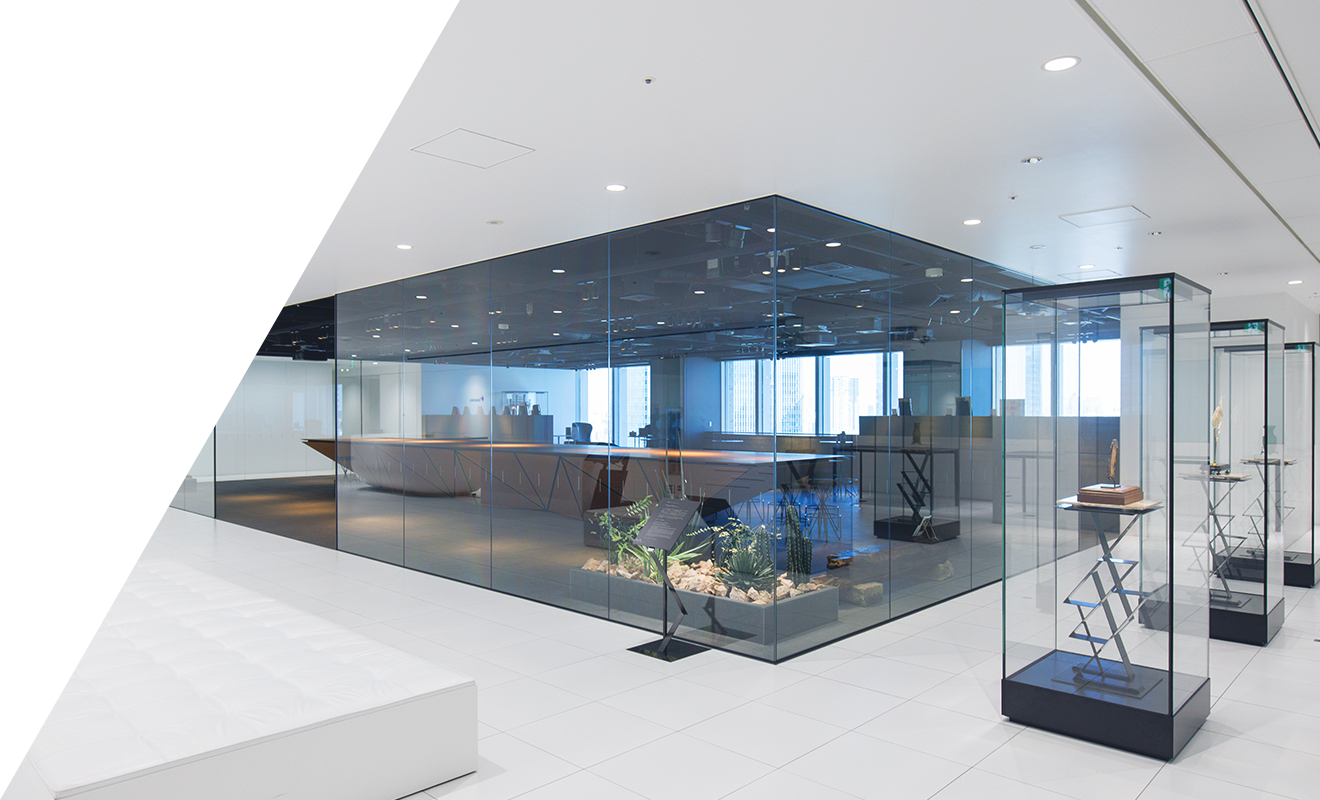




Tanseisha, in collaboration with Japan Airport Terminal Co., Ltd. (Headquarters: Ota-ku, Tokyo / President and Chief Executive Officer: Kazuhito Tanaka), Kumamoto International Airport Co., Ltd. (Headquarters: Kamimashiki-gun, Kumamoto Prefecture / President and Director: Hideaki Yamakawa), and participating companies of "terminal.0 HANEDA," a research and development base working to solve problems at Haneda Airport, will begin a demonstration experiment to verify the effectiveness of environmental improvements at security checkpoints at Kumamoto Airport on March 20th (Friday, national holiday) and at Haneda Airport on April 1st (Wednesday). In this project, Tanseisha was in charge of spatial design and overall Direction.
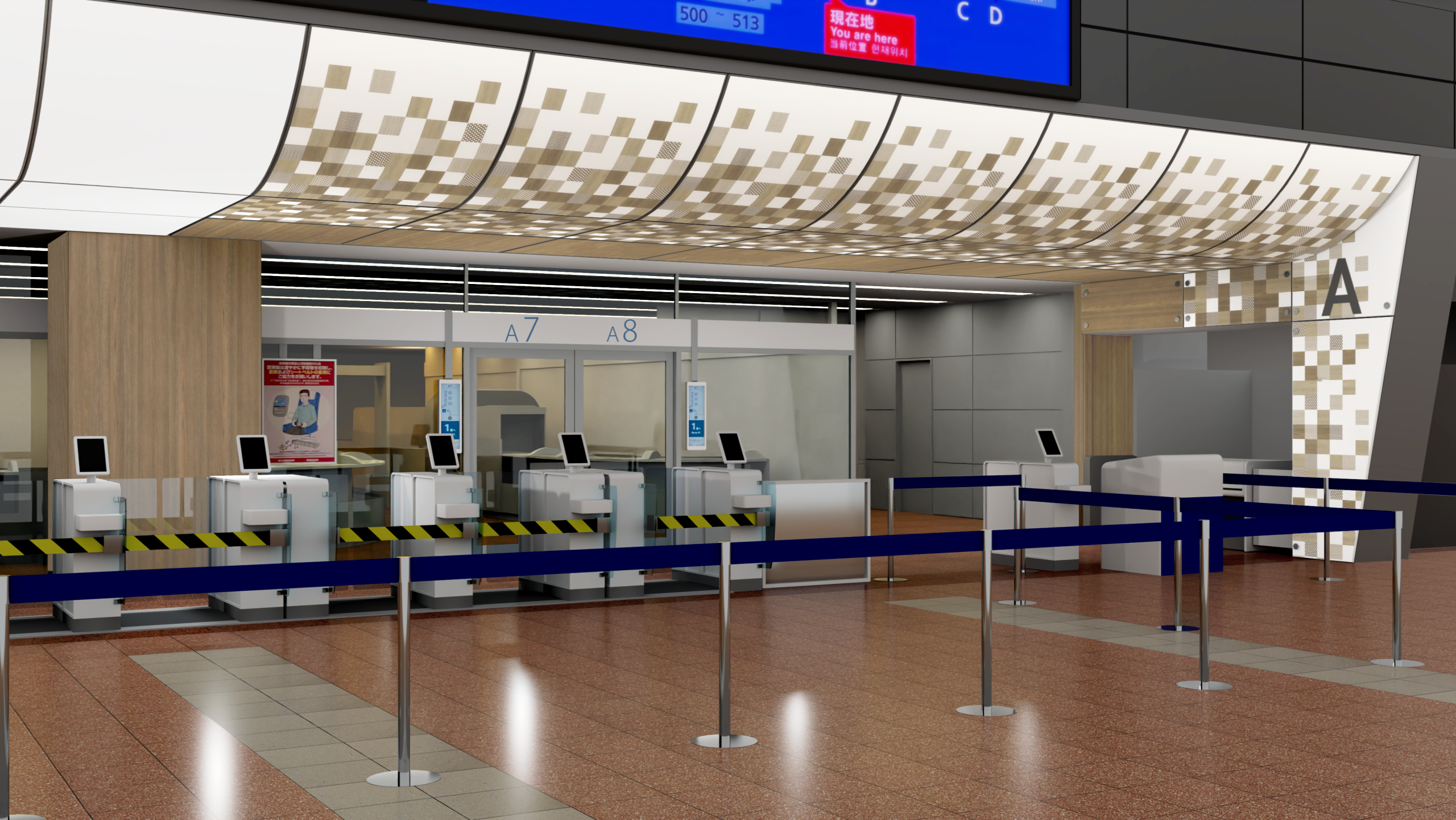
Haneda Airport Security Checkpoint Design Image
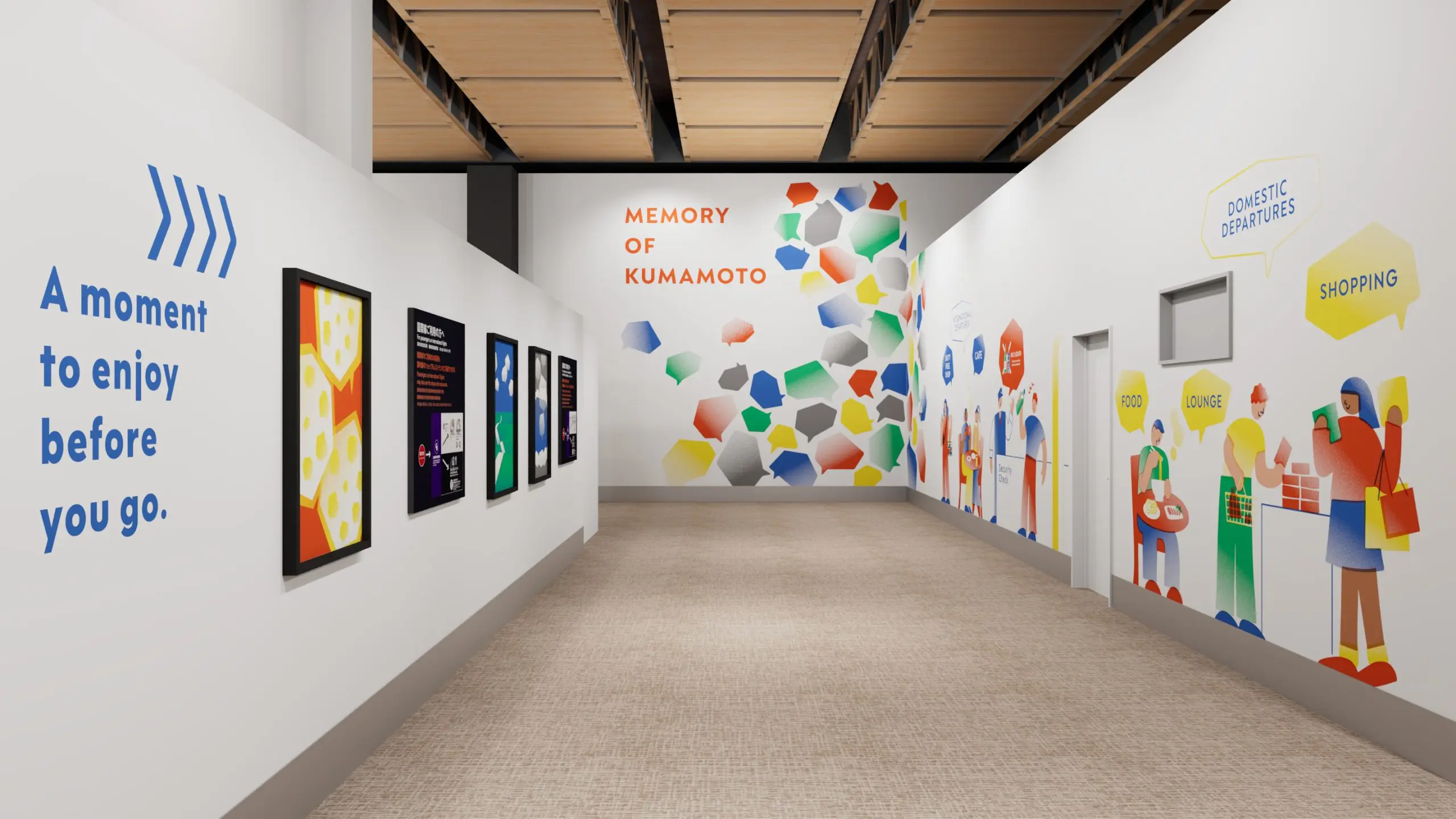
Design image of the passageway at Kumamoto Airport security checkpoint.
While airport security checkpoints are an essential process for ensuring aviation security, they are often psychologically burdensome for passengers due to congestion, long waiting times, and the tension associated with inspections. Furthermore, security personnel are required to maintain a high level of concentration in this environment. To address these issues, this demonstration experiment will utilize research findings from "terminal.0 HANEDA" and employ approaches tailored to the specific characteristics of both Haneda and Kumamoto airports to verify reductions in passenger stress and improvements to the working environment for security personnel.
News Release
Main demonstration experiment contents at each airport
1. Haneda Airport
To alleviate stress in spaces prone to psychological burden, we are verifying the effectiveness of environmental improvement through Spatial Production that utilizes human senses (the five senses). Furthermore, by incorporating the concepts of the spatial evaluation standard "WELL certification" into the spatial design, we aim to improve the quality of the environment and achieve well-being for both passengers and inspectors. In addition, we are receiving advice and supervision from point0 Co., Ltd. regarding the construction of the well-being environment.
*The notation in parentheses is a classification of the measures taken based on the concept (evaluation criteria) defined by "WELL certification".
[Spatial Design (Heart)]
By adopting environmental graphics that are mindful of biophilic design, the sterile impression of the inspection area is mitigated.
Core company: Tanseisha
[Lighting Plan (Light)]
The lighting environment is designed to be calming, with gradual changes in illuminance and color temperature, visually relieving tension.
Core company: Tanseisha
[Fragrance (Heart)]
At the entrance to the inspection area, a natural fragrance is sprayed to ease tension and deepen breathing, creating a pleasant air environment. Simultaneously, the diffusion rate of the fragrance is measured.
Core company: TS Aromatique
[Wind (Air)]
We installed a device that replicates a pleasant natural breeze to alleviate the feeling of lingering in the waiting line.
Lead company: Okamura
[Furniture and fixtures (for exercise)]
By providing electric height-adjustable desks, multi-functional chairs, and task lights, we reduce the physical strain on inspectors and support their physical and mental health, as well as their ability to maintain a high level of concentration.
Lead company: Okamura
[Sound Environment (Sound)]
Sound-absorbing material was installed next to the inspector's desk to reduce work-related stress caused by impact noises from equipment and trays.
Lead companies: DAIKEN, TOA
[Sustainability (Materials)]
We installed packing tables made from recycled plastic bottle caps collected at airports and other locations, as well as slipper storage fixtures made from Environmental Consideration paper building materials.
Leading companies: Supermate, Tanseisha
Period: April 1, 2026 (Wed) - June 30, 2026 (Tue) (tentative)
Location: Haneda Airport Terminal 2, 2nd Floor, within Security Checkpoint A (some lanes)
Partners: Okamura Corporation, Supermate Corporation, DAIKEN Corporation, TS Aromatique Corporation, TOA Corporation
2. Kumamoto Airport
To alleviate the anxieties of international passengers and ensure smooth guidance and directions to security checkpoints, we will utilize intuitively understandable visuals and Spatial Production that leverages local characteristics. This will reduce congestion and enhance the sense of anticipation for travel. Furthermore, by Spatial Production highly visible graphics and scents, we will create a colorful and stress-free work environment not only for passengers but also for security personnel.
[Environmental Design]
The design incorporates graphics that express the unique character of Kumamoto and a diverse, soft color scheme. It refreshes the sterile space, Spatial Production an environment where both passengers and inspectors can feel cheerful.
Core company: Tanseisha
[UX Design]
Rules regarding prohibited items and other restrictions are visualized using friendly, original illustrations and pictograms. By supporting intuitive understanding, this helps alleviate passenger anxiety and reduces the burden on inspection personnel.
Core company: Tanseisha
【Scent】
By spraying fragrances that are expected to have a relaxing effect, we aim to alleviate tension before the examination and reduce the work-related stress of the examiners.
Lead company: KALMOR
Period: March 20, 2026 (Friday) - Until further notice
Location: Passageway from the international departures entrance to the passenger security checkpoint at Kumamoto Airport
Partner: KALMOR Co., Ltd.
Future outlook
Based on the quantitative and qualitative evaluation data obtained through this demonstration experiment, Tanseisha will promote the development of a comfortable environment for both users and employees, and will work to realize a spatial model that creates new added value for security checkpoints. Leveraging the knowledge gained from this demonstration experiment, we will utilize this as a spatial solution that simultaneously provides a smooth passage experience that alleviates psychological tension and improves the well-being of those working there. Going forward, we aim to expand this not only to airports both domestically and internationally, but also to facilities in other industries that require high levels of security and hospitality.
About "terminal.0 HANEDA"
This R&D and co-working hub, established by Japan Airport Terminal Co., Ltd., which constructs, manages, and operates the passenger terminals at Haneda Airport, in collaboration with companies and organizations participating in the "terminal.0 HANEDA" initiative, is dedicated to research and development and demonstration experiments with the airport as its main theme. The facility was designed and constructed by Tanseisha, and our company is also a participating company. Under the theme of "Everything an airport can do to move people's hearts," we are conducting research and development aimed at solving airport issues and realizing "the future of Haneda Airport," focusing on areas such as "improving security screening," "space design and art utilization," "cutting-edge technology DX," "work styles," and "future airport-related issues."
"terminal.0 HANEDA" website: https://www.tokyo-airport-bldg.co.jp/terminal0/
Please note that this may be subject to change without prior notice.