





Our company, together with six other companies and organizations, including Kanemaru Shoten Co., Ltd. (Noto Town, Ishikawa Prefecture), which is working to reuse building materials and fixtures that are no longer in use on the Noto Peninsula, established the "Noto Upcycle Platform" on Monday, June 1, 2026, marking two and a half years since the earthquake.
This organization is a broad-area network designed to promote creative reconstruction from the earthquake disaster by reviewing and reusing old timber, old building materials, and old tools from the 13 cities and towns in the Noto region designated under the Peninsula Development Act, from an "upcycling" perspective. Moving forward, we will seek participation from organizations that support this purpose, strengthen collaboration with diverse external partners, including those in the fields of architecture and manufacturing, and work to disseminate information that connects Noto's history to future generations, co-create products, and create concrete utilization projects.
News Release
Background of the platform's establishment
The 2024 Noto Peninsula Earthquake damaged many buildings, and more than 40,000 buildings were targeted for public demolition. Among them were many traditional buildings that had withstood the harsh winds and snow along the Sea of Japan coast and supported the lives of families and local communities for many years. Faced with the reality that many of these buildings would be incinerated during the reconstruction process, volunteers throughout Noto launched a "reclaimed material rescue" project to save building materials and fixtures from buildings before demolition, and our company also participated. The recovered materials have been transformed into interior materials and furniture and are being used both within and outside the region, playing a role in connecting the memories of people's lives to future generations.
On the other hand, collaboration among implementing organizations has been limited until now, and know-how regarding collection, storage, and utilization has been accumulated individually by each organization. In particular, developing ways to utilize large materials such as columns and beams, which tend to have limited uses, and building cooperative systems with diverse players that transcend regions and industries are urgent issues.
At Tanseisha, the "Regional Revitalization Support Office" played a central role in this initiative. Now that the publicly funded demolition is complete and we are moving towards full-scale urban development, we have established this platform as an organization to promote broad regional cooperation centered on "upcycling" in order to accelerate the "creative reconstruction" of the Noto Peninsula.
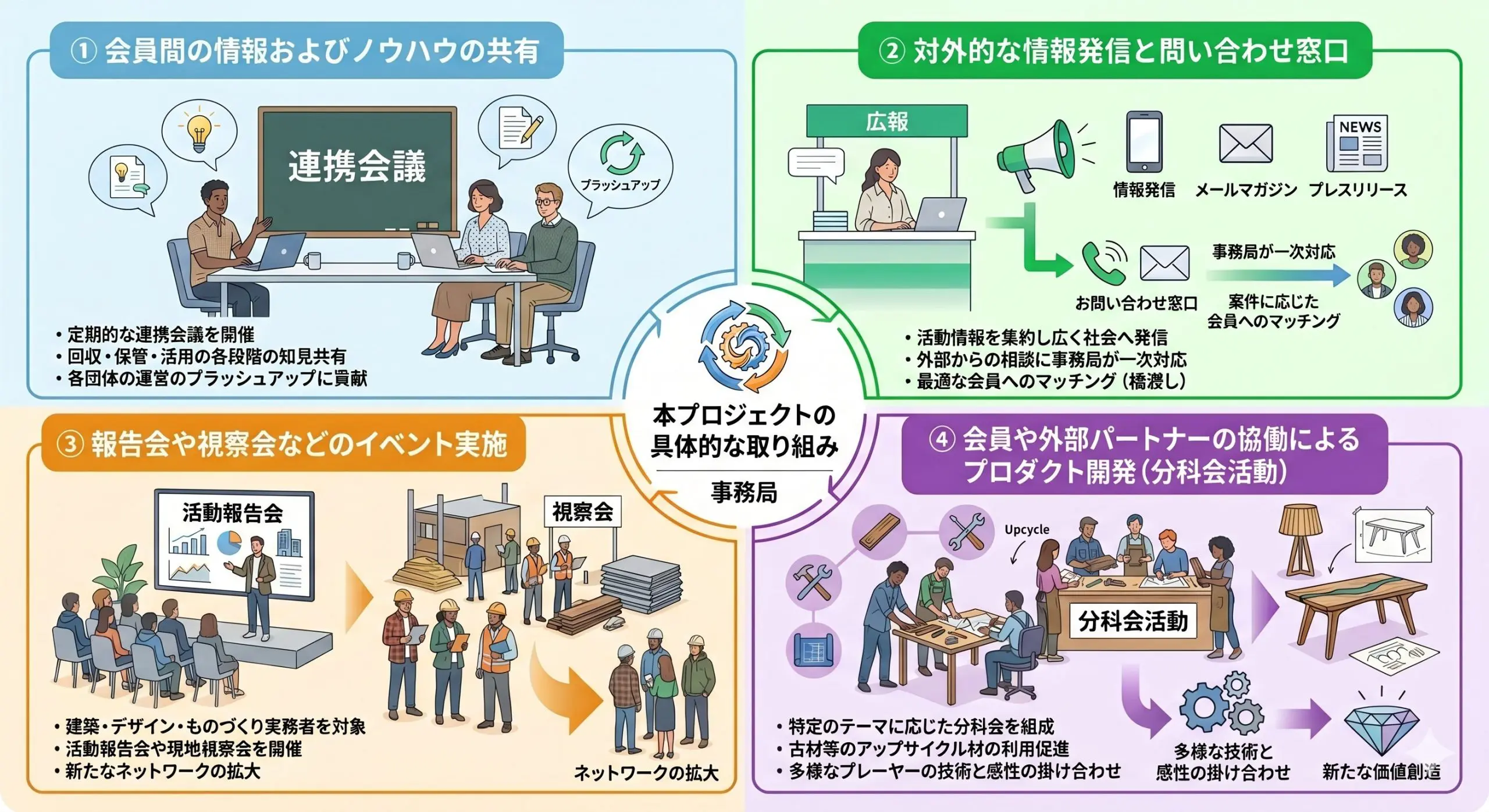
Specific initiatives
This platform will not only facilitate the sharing of information and know-how among members, but will also provide a centralized information dissemination and comprehensive point of contact for external partners, including those involved in architecture and manufacturing. Furthermore, we will promote initiatives to pass on Noto's resources to the next generation, such as product development through collaboration among members.
Expected effects of this project
① Creating "related populations" centered on upcycling
The Noto Peninsula region is facing a rapid population decline, making the involvement of diverse individuals essential for maintaining social functions and passing on culture. Therefore, the existence of "relationship population"—people who are neither migrants nor tourists, but who maintain a continuous connection with the region—is crucial. The connections forged through this activity will spread to new relationships among diverse individuals, creating a creative environment where both residents and visitors can gain new inspiration and learning.
② Fostering a culture that rediscovers value and makes use of old things.
Reusing old materials and antique building fixtures not only contributes to the environment by reducing CO2 emissions, but also preserves the design value (vintage value) cultivated over many years. In Japan, where the decluttering of houses and household goods is accelerating due to the declining population, widely presenting the option of "using instead of throwing away" is the first step towards a sustainable circular society. By increasing awareness of this platform and expanding the circle of participation, we aim to re-evaluate the value of old things and foster a culture of cherishing and passing them down.
Participating companies
*In Japanese alphabetical order
This platform designates companies and organizations based in the Noto region (12 cities and towns north of Kahoku District in Ishikawa Prefecture and Himi City in Toyama Prefecture, totaling 13 cities and towns) that are designated as areas for implementing peninsula development measures under the Peninsula Development Act, and that engage in upcycling activities utilizing Noto's resources, as "regular members." In addition, companies and organizations both inside and outside the Noto region that collaborate with regular members to engage in upcycling activities utilizing Noto's resources are designated as "partner members."
Kanemaru Shoten Co., Ltd. (Noto-machi, Hōsu-gun, Ishikawa Prefecture / Secretariat)
In 2025, the grandchildren and great-grandchildren inherited a shop in the Ushitsu district of Noto Town, which was founded by their grandparents around 1918, and are now challenging themselves with seven businesses, including demolition and reclaiming old materials. Furthermore, with the theme of "living together" with their companions, they are challenging themselves with businesses that pass on the inherited assets of the Noto Peninsula along with their stories.
WEB: https://www.facebook.com/kanemaru.inc
Reclaimed Wood Create Aogumi (Shiga-machi, Hakui-gun, Ishikawa Prefecture)
Based in the Tomiki district of Shiga Town, Ishikawa Prefecture, we are engaged in a business that creatively utilizes discarded items. Following the earthquake, we collaborated with Noto Fukko Lab, Tanseisha, and Kanemaru Shoten to carry out the "Noto Used Wood Rescue" project. In the future, we will shift our activities to focus on the utilization of used wood, and we will also develop a used wood Showrooms as a base for disseminating information about the western Noto region.
WEB: https://aogumi-kozai.com/
Suzu Joinery Bank (Suzu City, Ishikawa Prefecture)

Based in Suzu City, the "Suzu Joinery Bank" rescues, records, organizes, and stores wooden joinery from houses demolished after the Noto Peninsula Earthquake. By reusing these pieces in homes, community centers, and shops being rebuilt, mainly in the Oku-Noto region, they contribute to the recovery effort. This project records the small stories of this town along with the feelings of the owners, and delivers them to the community, thereby reconstructing the cycle of these activities.
Nakazen Construction Co., Ltd. (Tsubata-machi, Kahoku-gun, Ishikawa Prefecture)

Nestled in the mountains of Tsubata Town, Ishikawa Prefecture, "Mokuzouko" is a complex facility that combines craftsmanship and the enjoyment of nature, housed in a renovated timber warehouse. It features a gallery and cafe that rescues old timber and building materials and proposes new value, as well as the prefecture's only MTB park. Operated by Nakazen Construction, it is a place where people can create a richer future through play and creativity.
Website: https://mokuzouko.com/
Noto Fukko Lab, a general incorporated association (Wajima City, Ishikawa Prefecture)
This organization was established with the aim of "deepening relationships with people inside and outside the region and contributing to the creation of a sustainable and prosperous community by cultivating a lifestyle in the satoyama (traditional rural landscape) of the Noto Peninsula." As one of its projects, it has been implementing the "Noto Old Timber Rescue Project" since May 2024. With the cooperation of many people, it has rescued old timber and old tools from approximately 90 houses, temples, and other locations.
WEB: https://notofukkolabo.net/
Himi Old Wood Knotwork (Himi City, Toyama Prefecture)

Himi Old Timber Knotwork is an organization in Himi City, Toyama Prefecture, that extracts reusable timber from houses damaged by the disaster and connects it to the next generation of users. The name combines "knot" and "Noto," reflecting the organization's goal of creating connections between people and old timber. The organization aims to build a resource-recycling reconstruction process, with citizens, businesses, and students working together.
WEB: https://sites.google.com/view/knot-work
TANSEISHA Co., Ltd. (Minato-MINATO CITY, Tokyo / Partner Member / Secretariat Support)

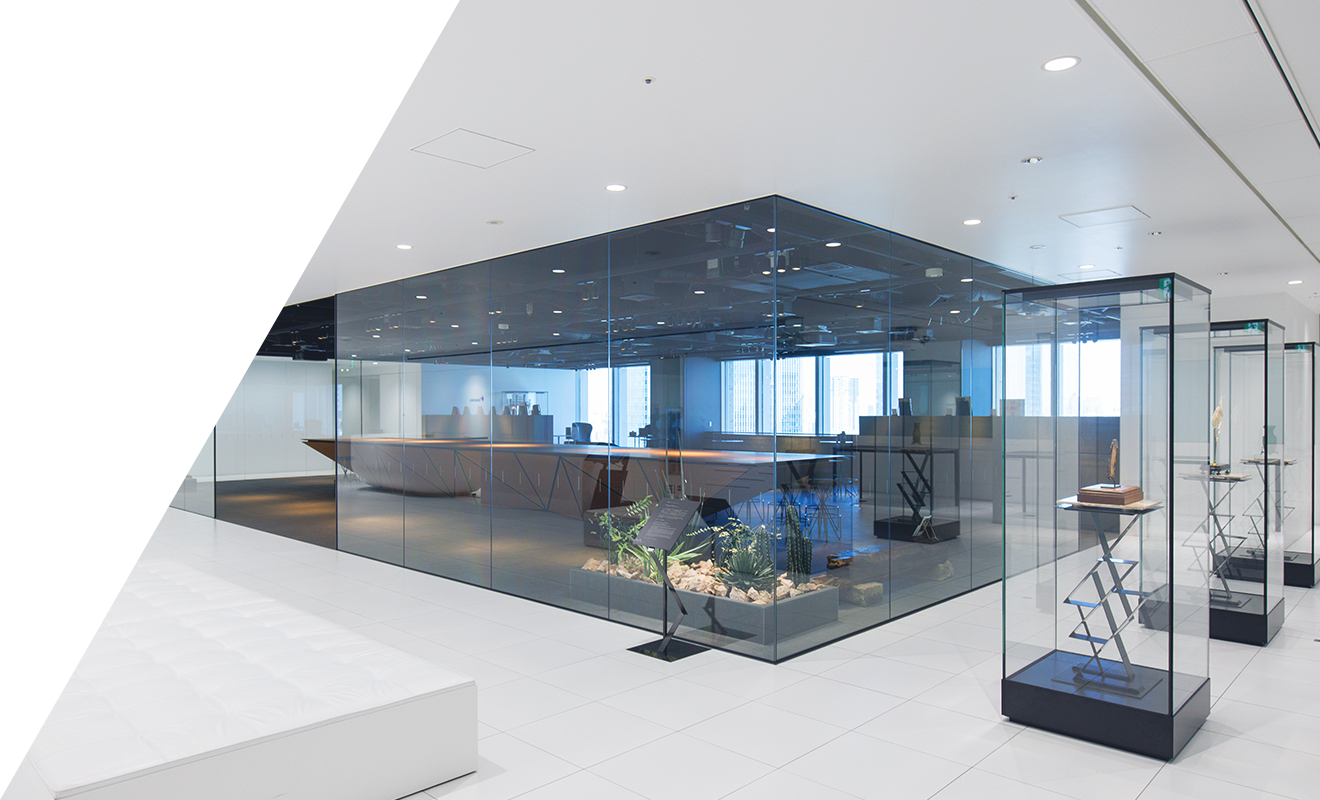
As Comprehensive display business we create spaces for commercial and cultural facilities nationwide. In May 2024, we launched the "Noto Antique Wood Rescue Project" with Noto Fukko Lab, a general incorporated association. We have been in charge of project promotion, including secretariat management, public relations, and utilization. We also manufactured and use tables made from antique wood from Noto in the meeting space of our own office.
Examples of using reclaimed wood at Tanseisha's office (WEB media "Ba to Hito"): https://batohito.tanseisha.co.jp/sustainability/sustainable-office-case/
WEB: https://www.tanseisha.co.jp/
Future developments
We will conduct public relations and exchange activities to create new connections centered around upcycling.
[Summer Site Visit 2026]
Date: August 22, 2026 (Saturday)
Sites visited: Noto Fukko Lab Old Timber Warehouse (Wajima City, Ishikawa Prefecture), and others.
Target audience: Architects, craftspeople, and others interested in utilizing reclaimed wood.
Content: The Noto Upcycle Platform regularly holds "field trips" where members visit each other's practice areas. In addition to representatives from member organizations, anyone interested in upcycling old materials and tools is welcome to participate in these field trips. We hope you will interact with local members working on upcycling and experience the charm of the Noto Peninsula and old materials.
*Further details will be announced via email newsletter and on the official website as soon as they are decided.
<Organization Overview>
Organization Name: Noto Upcycle Platform
Establishment date: Monday, June 1, 2026
Secretariat: 29-1 Utsutsu, Noto-machi, Hōsu-gun, Ishikawa Prefecture (within Kanemaru Shoten Co., Ltd.)
Official website: https://www.noto-upcycle-platform.org/
Business activities: Sharing knowledge and know-how about upcycling activities in the Noto region, collaborative public relations and information dissemination both within and outside the region, and initial response to inquiries about upcycling.
About the Regional Revitalization Support Office
At Tanseisha Group, centered around our "Regional Revitalization Support Office," we comprehensively examine the challenges facing local communities and, as a partner to the region from the initial stages of project conception to operational participation, create new stories for a vibrant future for these areas. Leveraging the research, planning, and implementation capabilities cultivated through creating spaces rooted in communities throughout Japan, along with the know-how of the Tanseisha Group, we create businesses and bring vibrancy to local communities together with them.
(Detailed brochure: https://www.tanseisha.co.jp/resource/Tanseisha_Chiiki-Sousei-Shiennshitsu_2024.pdf)
Related information
Business Introduction > List of Related Businesses > Regional Revitalization Support Office - Creating a vibrant community together with the local community
TANSEINOTE: Creating a new cycle through connections between the region and businesses: The challenge of the Regional Revitalization Support Office