





Site Search
Resource circulation/coexistence with nature
- TOP
- Sustainability
- ESG Initiatives: E (Environment)
- Resource circulation/coexistence with nature
Promoting the circular economy
We are working to build a system that recycles resources throughout the entire value chain (planning, procurement, construction, and disposal), striving to reduce environmental impact and make effective use of resources.
Planning of non-flammable wall material "R Nice"
Focusing on "non-combustible wall materials," which are essential for building restaurants with kitchens but were not being recycled, Tanseisha planned and designed a new building material, reviewing the raw materials of the building material, and the manufacturing company carried out the development, resulting in the non-combustible wall material (decorative calcium silicate board) "R Nice." By collaborating with Tanseisha, the manufacturing company, the intermediate processing facility, and the recycling facility, a flow that enables 100% material recycling has been established.
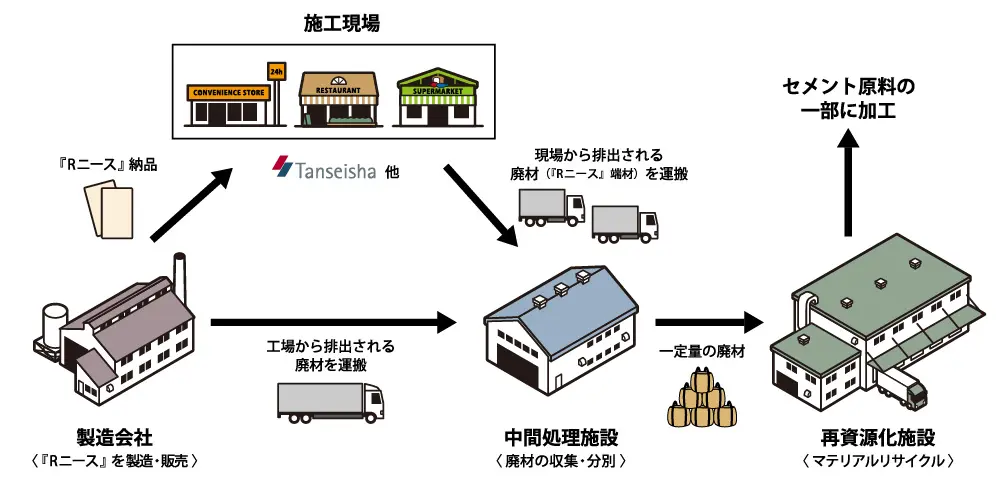
Flow for 100% material recycling (image)
Related Information | Our Website "Announcements"
Expanding the area where "RNIHS," a non-combustible wall material that can be recycled 100% through planning and flow construction, is available.
We have developed a fireproof wall material called "R Nice" and created a process for 100% material recycling
Promoting the circular economy through the use of antique dealer licenses.
We have established a value chain that involves purchasing discarded and stored fixtures and furniture generated during the renovation of stores and hotels, based on our antique dealer license (Tokyo Metropolitan Public Safety Commission License No. 301102515751), and then forwarding them to specialized reuse companies.
• Creation of economic and environmental value
We are shifting from assets that were previously disposed of or stored at great expense to assets that we "buy back." This helps our client companies reduce disposal costs (economic efficiency) and waste generation (reduced environmental impact), supporting ESG management and the enhancement of brand value.
- Providing a transparent, one-stop resource recycling service.
We manage the entire process, from construction to reuse evaluation, removal, and purchase, through a single point of contact, in conjunction with the renovation work schedule. We provide a smart resource recycling system that ensures traceability while minimizing the burden on the customer in terms of arranging contractors and other processes.
Reducing environmental impact throughout the value chain
Reducing the volume of waste plastics
We are working on "volume reduction," which involves shrinking waste plastics, which make up a large portion of industrial waste, by placing them in compression bags. This reduces the number of transport vehicles, leading to a reduction in CO2 emissions from those vehicles. At one site where this system has been implemented, we were able to reduce the volume by approximately 9 4-ton container trucks, resulting in a reduction of approximately 3.1 tons of CO2 emissions.
Efficient use of building material samples
Regarding building material samples necessary for space creation, we have established a company-wide sample room that is operated in cooperation with various manufacturers, and we also utilize a service that allows samples from multiple manufacturers to be packaged and returned together. This not only reduces the number of sample deliveries and packaging materials, but also contributes to promoting the return and reuse of building material samples.
Waste reduction and goal management in business activities
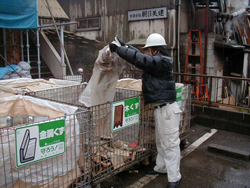
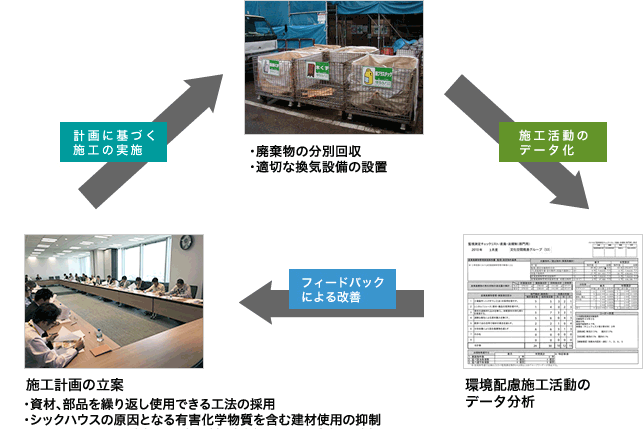
Proper management and reduction of industrial waste at construction sites
• Planning and continuous improvement of management plans (PDCA cycle)
In accordance with environmental laws and regulations, we develop management plans to reduce the generation of industrial waste for each individual project, and we strive to achieve an implementation rate of over 90%. After construction, we record the amount of waste generated and compliance with legal regulations, and use this information to continuously improve future plans.
- Ensuring proper handling through a committee system
At the monthly Safety and Health Committee meetings, we review relevant documents and processing status, and provide guidance to ensure proper disposal. Furthermore, through the Industrial Waste Countermeasures Committee, we confirm management policies and sorting rates, and actively promote the introduction of effective measures to reduce industrial waste (such as pre-cutting, 3Rs, reduction of packaging materials, and adoption of economical dimensions).
- Setting targets for sorting rates and improving recycling rates
To reduce the amount of waste ultimately sent to the final disposal site, we have set an annual average sorting rate target of 70% at construction sites. We are striving to improve the recycling rate by reducing mixed waste and thoroughly implementing sorting at the site.
Action items
- ・Factory production (pre-cut and knock-down method)
- ・Adoption of rental (reused) materials and equipment
- ・Reducing the excessive delivery of materials and providing guidance on taking surplus materials back
- ・Reduce excess packaging when transporting materials
- - Reduction of waste materials by utilizing economical dimensions
- ・Reducing mixed waste through separate collection
Targets and achievements for reducing industrial waste at the worksite (Tanseisha Co., Ltd. only)
| 2021 January Period |
2022 January Period |
2023 January Period |
2024 January Period |
2025 January Period |
2026 January Period |
|
|---|---|---|---|---|---|---|
| Industrial waste management plan implementation rate | Annual target: 90% | ー | ー | 91.5% | 92.6% | 92.3% | 92.9 % |
| Company-wide average sorting rate of industrial waste generated at construction sites | Annual target: 70% or higher | 61% | 69.9% | 70.4% | 71.2% | 67.1% | 67.2% |
* Collection period for each fiscal year: February 1st of the current year to January 31st of the following year
Reduce waste and resource use in offices
We have established a centralized space for sharing and managing stationery, documents, envelopes, etc., throughout the company. We also prioritize refills in our stationery stock and promote thorough waste reduction and sorting from the office. Furthermore, when renovation work is carried out at each location, we request a recycling specialist to pick up furniture and fixtures, and we also promote the recycling of workwear, helmets, safety belts, and other equipment used on site.
Furthermore, as part of resource utilization management, we monitor the amount of office paper used and strive to reduce paper usage compared to the previous year by digitizing document circulation and promoting online meetings.
*Paper usage in fiscal year 2024 (quantity data of paper used in multifunction printers) was 2,732,500 sheets, a slight increase from 2,503,500 sheets in fiscal year 2024.
Biodiversity conservation and sustainable resource procurement (coexistence with nature)
We manage the impact of our business activities on the natural environment and aim for coexistence between society and nature based on a sustainable procurement policy.
Promoting a joint project to incorporate wood into interior design.
Together with Tree to Green, Salt Terminal, and Takenaka Corporation, we established Tsumikasane Co., Ltd. as the project's operating company. As a core project of the "Kiso Forest Grand Cycle Concept," which aims to build a circular economy utilizing the forest resources of the Kiso region, we are jointly developing a project in Shiojiri City and Kiso Town, Nagano Prefecture, that involves plywood manufacturing and interior material processing.
This project aims to create new value for forest resources in the Kiso region and revitalize the local economy by transforming small-diameter timber, which has previously been difficult to utilize effectively, into high-value-added plywood that can be used in construction, interior design, and furniture.
Furthermore, Kokuyo and Takizawa Veneer have since joined this project, and the initiative has expanded.
Related Information | Our Website "Announcements"
A collaborative project to recycle small-diameter timber from Shinshu into high-value-added plywood has been named "NOITA".
Kokuyo and Takizawa Veneer will participate in the "(tentative name) Shingohan" project.
We have launched a collaborative project tentatively named "Shingohan" to regenerate small-diameter timber into high-value building materials.
Obtained the forest certification system "FSC®-CoC Certification"
Tanseisha's headquarters has obtained FSC®-CoC certification, the most widely used forest certification system in the world.
FSC® certification is a forest certification system that certifies "proper forest management" as defined by the Forest Stewardship Council®, an international non-profit organization that aims to spread responsible forest management worldwide. There are two types of certification: "FM certification (Forest Management certification)," which examines and certifies forest management based on 10 principles and 70 standards that balance the environment, society, and economy, which were established by agreement with various stakeholders around the world, and "CoC certification (Chain of Custody certification)," which covers the processing and distribution process of forest products. Strict examinations are conducted by independent third-party organizations.
The "CoC certification" that Tanseisha has acquired is awarded to companies that are certified as conforming to standards and rules established by the FSC to prevent the mixing of unqualified wood during processing and distribution. Tanseisha promotes the use of properly managed forest products when proposing and selling the wooden products it handles.
| License number | FSC®C179924 |
|---|---|
| CoC certification number | SGSHK-COC-350698 |
| Acquisition date | 2022-07-07 |
Case Studies
As original, environmentally friendly products, we have produced our first furniture pieces, a "side table" and a "coat hanger," made entirely from FSC®-certified wood. These two products were designed and delivered to fit the concept of the "Carbon Offset Room" in the co-working space "point 0 marunouchi," which aims to realize the "office space of the future."
Related Information | Our Website "Announcements"
We have acquired the forest certification system "FSC®-CoC Certification"
We have created custom-made furniture made entirely from FSC® certified wood.
Sustainable materials list
With the aim of raising awareness of sustainable building materials, strengthening our ability to propose them, and increasing their adoption, we are creating a list of materials that will lead to the creation of sustainable spaces and sharing this information with clients.
Donations to the "Green Fund"
Tanseisha supports the main purpose of the "Green Fund" promoted by the National Land Afforestation Promotion Organization (NLAPO) and donates to it.
The "Green Fund" will be used for various "reforestation and human resource development" activities, which will lead to the creation of forests in local communities and in Japan and overseas.
"Green Fund" (National Land Afforestation Promotion Organization website)
Prevention of environmental pollution and conservation of water resources
We manage the risks of health hazards and environmental pollution caused by chemical substances and promote the sustainable use of water resources.
Measures against sick house syndrome to prevent health problems
To create spaces that are safe and comfortable to use, we promote safe designs, properly manage the chemical substances used, and work to prevent air, soil, and water pollution.We implement sustainable designs and construction plans (construction review meetings), select certified materials in cooperation with designers, production staff, and other related parties, and manage the use of certified materials by defining essential items for on-site management and registering and recording on-site record photographs.
Effective use of water resources
In light of the importance of effective use of water resources in our business activities, we are committed to making improvements. Shinagawa Season Terrace, where Tanseisha's head office is located, is situated above the Shibaura Water Reclamation Center, and we not only save water and use gray water, but also make maximum use of the sewage heat and recycled water generated at the center. In addition to utilizing the stable sewage heat as a heat source, the recycled water is used for flushing toilets and irrigating plants.